
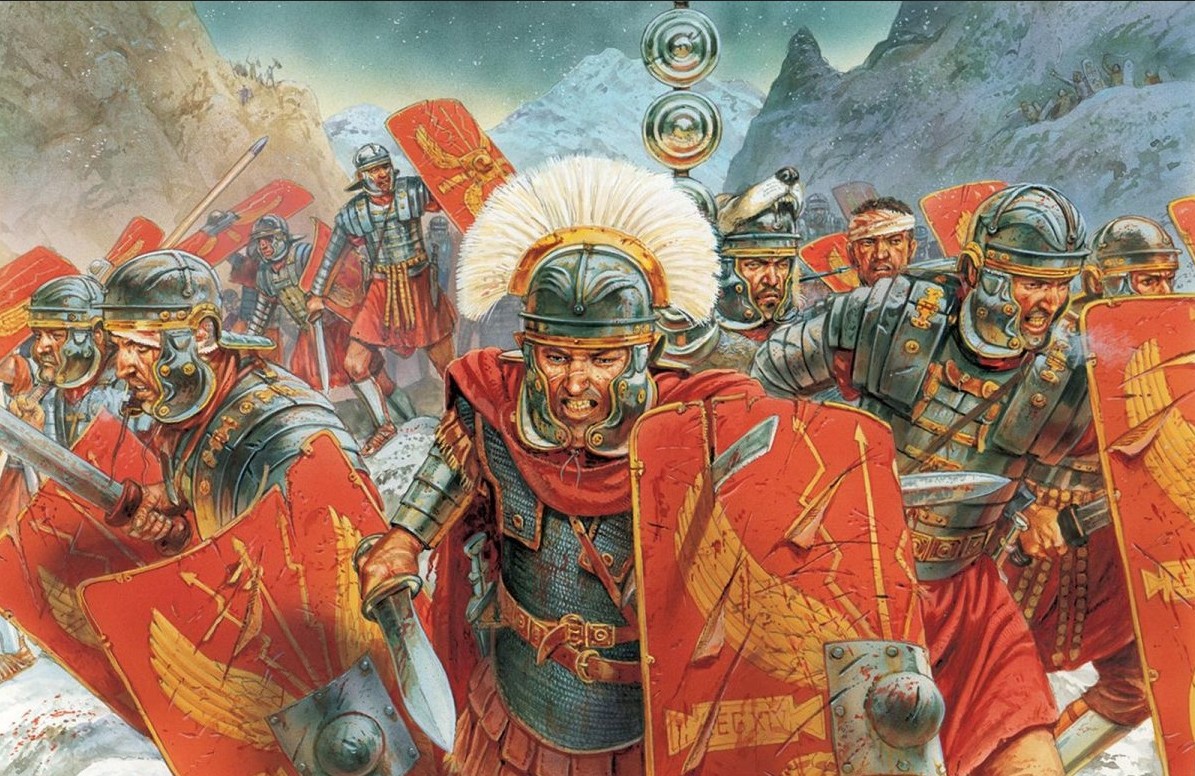
Editor’s note: The following introduction, written by Ian A. Richmond, is excerpted from The Roman Soldier, by Amédée Forestier (published 1928).
THE SOLDIER OF LOCAL NEEDS
Like all soldiers of the ancient world, the Roman soldier was originally the able-bodied man of a small community, fighting to protect his folk and his lands from jealous neighbours. There can be no doubt that the Romans were right in believing that they themselves became such soldiers as soon as Rome existed; so we go back to the middle of the eighth century before Christ, when the City had been founded upon a group of hillocks in the lower Tiber valley, where was a good river-crossing and fertile soil, exciting the jealousy of the hill-folk near by. The organisation of this first army is obscure, but analogy and tradition combine to show that, in order not to disturb the balance of power within the State, it was levied from the noble caste, and commanded by the King. The armour worn, as remains of burials show, did not differ much throughout Italy. But types were not yet classified, and much experiment was in progress. Offensive weapons were still the cutting-sword, carried upon the shoulder-strap, and the long thrusting-spear, both adapted to stand-up fighting at close quarters. It was necessary to make a stand in order to defend fields as well as hearths, since the loss of crops might have grave consequences for a small and isolated community.
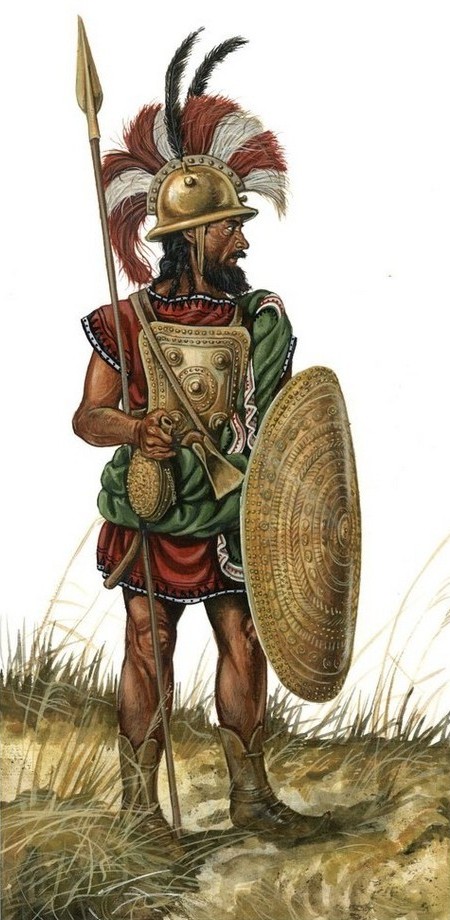
North of the Alps, where life was less settled, and in Greece, where land-hunger induced war, necessity compelled invention to march rather faster than in Italy. But even so early as the eighth century, the Etruscans (roving folk from the Near East, as is now universally understood) were bringing with them to Italy armour of essentially Greek type. Owing to its cost and cumbrousness, this armour never completely ousted the lighter and more pliant Italic type. Yet it created a standard of heavy-armoured infantry which was to last for some time.
It quickly became clear, however, that if good armour was the deciding factor in pitched battles, wealth was as important as nobility. This determines the next stage. The Roman state and her rivals grow, and the new model army, introduced by King Servius Tullius in 578-535 B.C., so tradition has decided, is based entirely upon quotas of wealth. All property-owning citizens serve as soldiers, and are arranged according to wealth and age. The regulation armour is graded by wealth, and the heaviest armed receive smiths for field-repairs. Discipline, the stabilimentum Romani imperii, is already recognised as sufficiently important to demand the institution of special divisions of buglers and trumpeters, who play tunes appropriate to special needs. Cavalry is organised; the horses and fodder are provided by a special tax, paid by widows and orphans who cannot fight. The arrangement of this army in battle has been much discussed. But it is clear that, whatever the details, the whole scheme is a close battle-line, six deep, based upon a stationary conception of fighting, and unsuited to quick movement or extended order. The army is still organised for home service.
Tradition dates the first important adaptation to the needs of foreign service to the time of the war against the neighbouring town of Veii. The campaign involved a ten-year siege (406—396), and the Roman soldier both went into winter-quarters and received pay for the first time. He is not yet a professional; but pay is required in order to compensate for so long an absence from home. The need for frequent aggressive warfare introduces a more open battle order; and a new weapon is invented, the heavy javelin (pilum), which is thrown before charging, and has a soft point, meant to bend and stick in whatever it penetrates. This is to be of great help in crippling those who depend for defence upon the shield. Much attention also is being paid to the art of encamping for the night. Soldiers are expected to be able to entrench themselves behind a mound and portable stakes, and their disposition in camp assumes regular order. In high command, the place of the King is now taken by one or both of two Consuls, elected yearly, and not always fitted to command armies. But this disadvantage is for the moment glazed over by the discipline and orderliness of the army, unequalled inside or outside of Italy. The Roman burghers have become the Stosstruppen of their day.
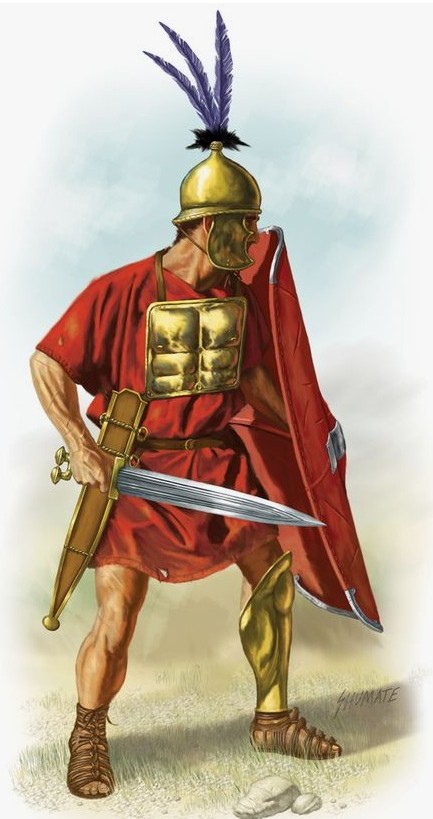
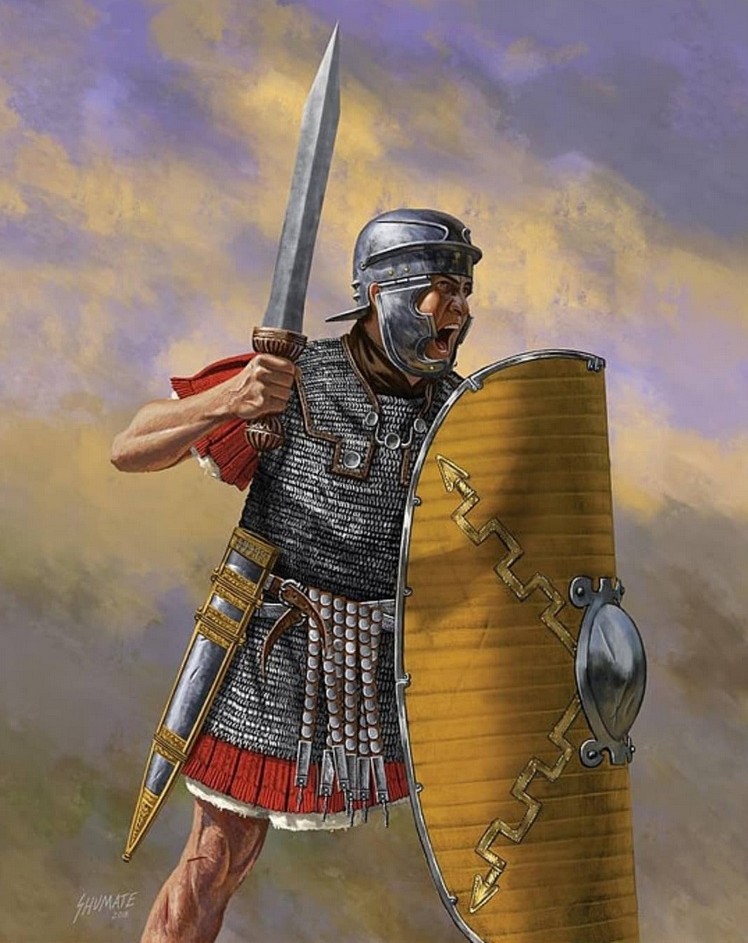
The orderliness thus acquired is accompanied by a standardisation in armour. A metal-plated leather cuirasse is evolved and worn by those who have the property-qualification to warrant the expense, while the poorer soldier wears a square breast-plate. And there is invented a new kind of shield, oblong in shape and convex; it is four feet high, and can be used to form a wall against charges, or a roof against missiles. Blows glance off the convex surface. So the army is now equipped for the offensive; and by the formation of alliances, by their breakdown, and by the formation of counter-alliances in turn, the Roman soldier comes to be acting throughout Italy. The allied states are expected to provide contingents for the army; but these are inferior in numbers, efficiency and discipline. Usually they provide light-armed troops and cavalry, in which the Roman army is deficient. The new army is almost universally successful, if well commanded, but it is not exempt from disaster amid new experiences. By a great charge with their sweeping swords, the Gauls mowed the Roman line down at the Allia (390), while Pyrrhus was to win later (280) a great victory by means of an elephant charge at Heraclea. But neither defeat was decisive; and the Romans soon learnt to adapt themselves to the new ways of fighting. The fault was more often with the Consul commander than with the soldier.
THE CHANGE FROM LOCAL TO IMPERIAL NEEDS
Until the close of the second century B.C., the army remains much the same. But it has become much more expert. It has had to face the long Hannibalic Wars, during which the whole freedom of Italy was at stake. And its success there is due to patience and discipline. much more than to brilliant tactics. Many times the inefficiency of a Consul almost lost all. Even discipline, which some commanders make a fetish, is grossly neglected by others, with disastrous consequences. On the whole, the army is becoming much more technical. The construction of spring-guns and siege-machinery comes to be studied as an art; the erection of an encampment is a matter of rule, and Polybius gives us a glimpse of the soldier-surveyors with their different coloured ranging-flags. But the war is an immense strain. After a great disaster like Cannae (216) slaves and ex-slaves have to be enrolled in the army. Still greater is the strain on the Italian allies, who are now becoming subjects rather than equals. The aid of mercenary troops from allied sovereigns or states outside Italy is not disdained, and this marks the beginning of an important method of supplementing the Burgher-army. In Rome itself recruiting becomes detested and evaded.
Despite the grievous lack of professionalism and coordination, the system survived the Punic wars. But soon afterwards, when it became necessary to govern already Spain, Macedonia, Greece, Tunisia, and presently, the South of France and Illyria, the collapse began. In order to govern these provinces the yearly magistrates, Consuls and Praetors, received provincial governorships as extensions of their year of office. This system relied too much upon the personal quality of the governor; and the police-work and guerilla warfare in the provinces and on the frontiers is wearing out the Burgher-army. Yet it is surprising what can be done. Already by 133, the armies before Numantia are constructing field-works equal in size and technical excellence to much of the work done by professional armies in later days. Important buildings, like granaries and barracks, have already arrived at something like standard pattern. No other army in the world is capable of constructing such field-works. But decay is setting in rapidly. By the end of the second century the citizen cavalry is gone, and in its place are enrolled auxiliary levies from the tribes of Gaul, Numidia, or Spain. The discontent in Italy is reaching fever-pitch. The principle that legionaries must be men of property still exists; the Romans are doing all possible to evade service; and more work is being foisted upon the unhappy Italian allies. Nor is the heavy infantry adapted to guerilla warfare; it has borrowed the Iberian stabbing-sword, but has not yet learnt to use it. Only towards the end of the century is the principle of drill borrowed from gladiators and introduced by Rutilius in Gaul, in order to enable the soldier to stand against mighty Gallic swordsmen. the innovation came too late to save the Burgher-army. At the close of the century, during the African war and the Cimbric invasions of Italy, thousands of citizens became martyrs to inefficiency, and demonstrated that the old-world conception of the army was impracticable.
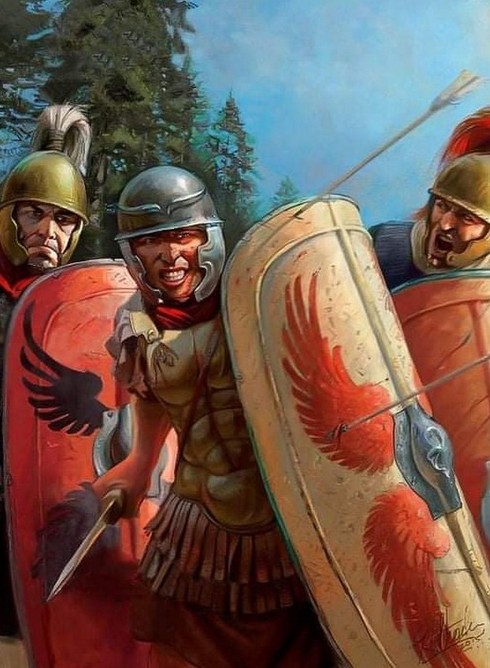
It fell to Marius, once a private soldier, to introduce the needed reform. The property-qualification for the legionary was abolished, and thus the character of the army was completely changed, for it could be adopted as a profession by the poor citizen. But this introduced a terrible danger to the state. The army now consisted of soldiers of fortune; and provincial governors, whose status has been noted, or generals, could now receive extensions of command to finish a given war. Suppose such a proconsul raised a faithful army, attached to him personally, who could turn him out of his command? Might he not become Dictator? This temptation to absolutism was great. It ruined Marius; it created Sulla. Presently, Crassus, Pompey and Cæsar were all to play for the same stake. Antony and Augustus repeated the process, and the end of it all was the Julio-Claudian Imperial House. In sixty years the reforms of Marius killed the Republic.
Yet these reforms were just in time to tide the state over an unbelievably grave crisis. The allies, unable to bear their woes any longer, engineer a great revolt. Rome is to be wiped out, and the new army is strained to the utmost in quelling the attempt. The principle of levying provincial troops en masse, and of giving to them the citizenship at discharge for services rendered, is recognised for the first time; and these non-Italic citizens, and their sons (Spaniards in the known case), become eligible for service in the legions. After the revolt there is an equally important change. All Italy to the Po (and soon to the Alps) receives the citizenship, and so the burden of legionary service is extended from the Romans to Italians the world over. There are no more Italian “allies,” and the tendency to enrol and enfranchise provincials continues. The stage is set for personalities who will gather about themselves a force to master the state. And the soldier remains Roman, but Roman in quite a new sense.
THE IMPERIAL ARMY
During the last century of the Republic all the tendencies so far described come to a head. For a moment, after Sulla had placed the machinery for controlling the appointments to provincial governorships in the hands of the Senate, it looked as if the constitution so reformed was going to be strong enough to save itself from pronunciamenti or military conspiracies. But by giving to Pompey the command of the whole Mediterranean for a Pirate War, the Senate committed political suicide. Henceforward the whole aim of every notable politician was to create such a command for himself. When Cæsar has built up a great army in Gaul, the time is ripe for the dissolution of the Republic; and the main question becomes whether anyone strong enough to control the armed forces will arise, or whether the whole Roman world will disrupt amid internal conflict. After the fall of Cæsar the position becomes so bad, that there is danger of the establishment of a monarchy on Eastern lines.
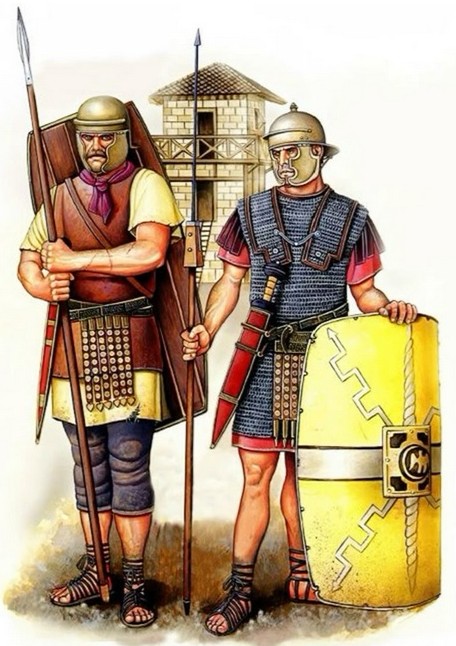
In the end Augustus emerges triumphant; and by slow stages he reforms the constitution, holding old Republican offices in new fashion and combination, and graced by the old title given by soldiers to their victorious general, Imperator. The government of military provinces is left in his hands, and administered through his legates, commanding limited troops through subordinate legionary legates, in turn appointed by the Emperor. The number of standing legions, each 4,000-6,000 strong, is settled for each province. Definite quarters are built for them; they become ultra-professional and steadily more provincial. Standing-quarters create small towns, in which a traditional soldier-class is reared. Some legions. at first share quarters; but this is too dangerous. It may cause grave mutinies, as in Pannonia. Again, the command of one or two legions among so few makes pronunciamenti possible. After the close of Nero’s reign there is an epidemic of them, not entirely stamped out until the end of the century. Joint encampments are abolished by then. But with the danger-limit of legions so low, the problem of Imperial Defence becomes complicated. Slowly the conquests of Cæsar in north-western Europe are rounded off. Early in the first century an Elbe-Danube frontier becomes a brief possibility; then the line recedes to the Rhine, and bulges out again to the Neckar. Britain is taken over, though the conquest is never completed; and early in the second century, Dacia and Arabia are added by Trajan. Citizen-legions cannot garrison effectively all those provinces, and, in order to solve the problem, the old auxiliary system is developed upon a large scale. Corps of provincials are levied from suitable peoples, and are quartered-five hundred or a thousand in paper strength-in forts of standard type, linked by military roads, which form lines of penetration or networks all over the frontier lands, and radiate from legionary fortresses. These folk use their native arms and make good frontier troops, half-soldier, half-police, receiving the citizenship on discharge after twenty-five years’ service. The frontiers become so settled that it is possible to control and watch all slight movements upon them, and to extract valuable dues at the entrances to the Empire. Much thought and energy is spent upon perfecting frontier control; frontier-roads receive block-houses and signal-stations. Boundaries are marked and become barriers : they are supplied with forts and a large garrison of auxiliaries. The barriers assume definite military form, and soon Hadrian’s Wall will provide a classic example of such evolution. Normally the system works perfectly, and in the second century it is the regular mode of frontier control all over the Empire. But it is not designed against invasions. In those moments the legions emerge and are expected to deal with the trouble. When they do not, there is a big disaster. But the frontier land is usually a wide net, in which the invaders can be caught without disturbing the peaceful non-military world. In times of peace the soldiers are kept busy with useful tasks of construction, not only in the military area, but outside it. Road-systems, dykes or canals, aqueducts or bridges, and frontier works are thus constructed without great expense. The soldiers build their own forts and quarters. But the work is usually done by legionaries who are more intensively trained, and have richer traditions than the auxiliaries.
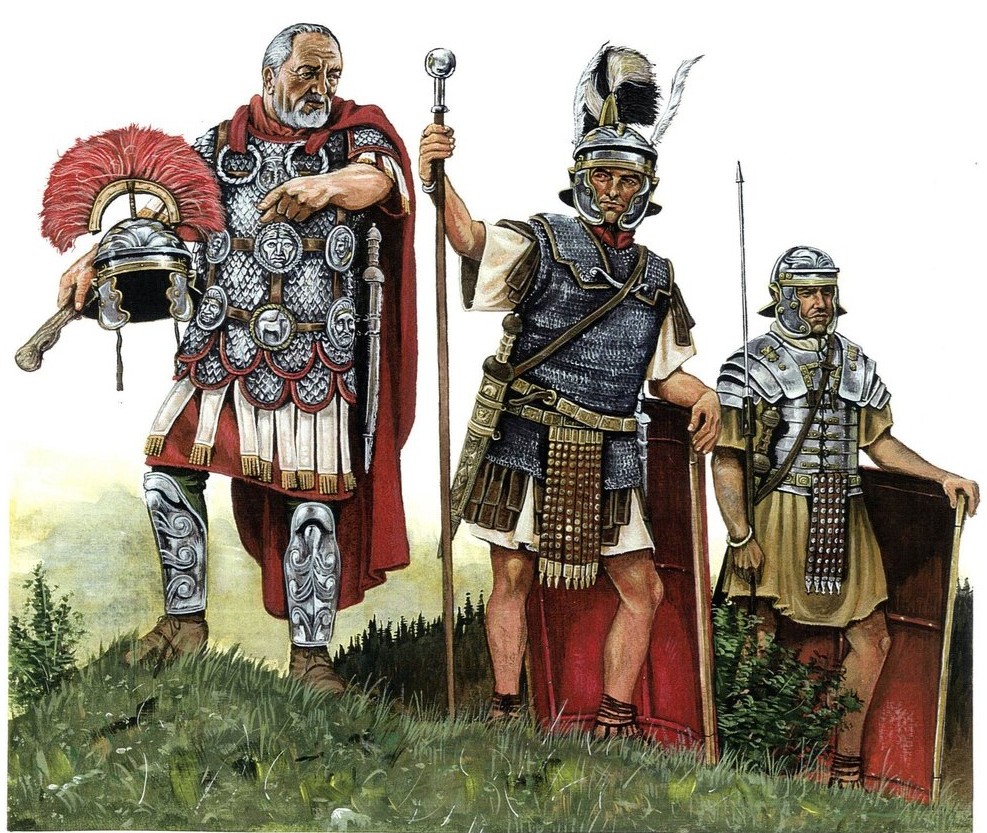
During the second century, however, the sharper of these distinctions are passing away, as once the distinction between Roman and Italian had done in Italy. As more provincials receive the citizenship, and as the legionaries, often themselves provincial, marry provincial wives, the sympathy of the army becomes steadily more provincial and less Italian. At the end of the century the feeling is so strong that Severus can enrol in the Imperial Guard legionaries who horrify the Capital by their bearing and uncouth language. The legionaries are now recruited on the spot, and are permitted by Severus to live out of barracks with their wives. The principle of local recruiting also applies to auxiliary regiments. Whatever their original nationality, they now absorb the natives of the province wherein they are located; and recruits all become citizens on their discharge, and they or their sons are eligible for the legions. In the end the legions become the Senior Service, and there is little real difference between them and the auxiliaries except in weapons, drill and name. The fact is recognised by Caracalla, who extends in 214 the citizenship to all free-born in the Empire. Within the Empire there is now no bar to service in the legions whatever. From becoming Italian, with provincial auxiliaries, the army has now become entirely provincial.
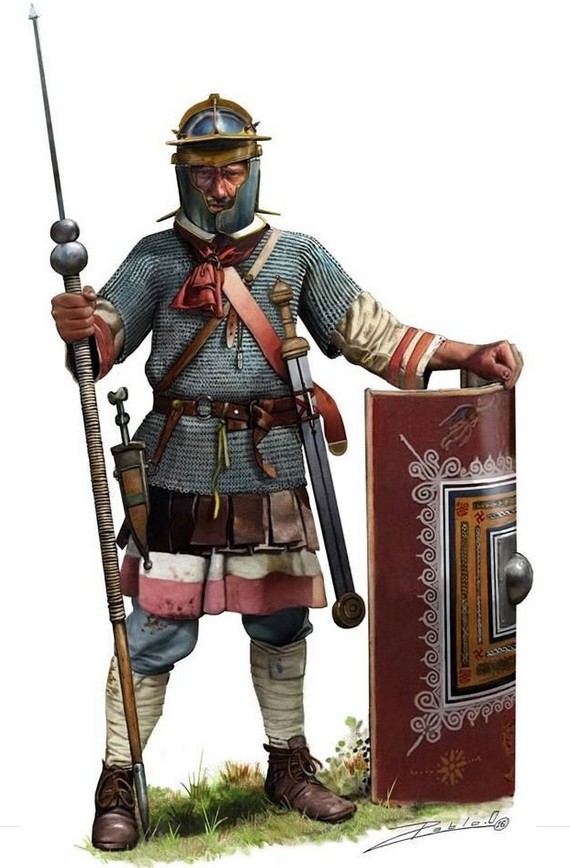
This system has grave dangers which emerge in the third century. The provincial spirit in the army now fosters the first-century idea that Emperors need not be set up from Rome as a matter of course. Φιλέι δὲ τικτειν ὕβρις.[1] It finds expression the moment that the supply of good Emperors fails. Commodus is followed by generals like Albinus of Britain, Pescennius Niger, and Severus. Forty years later pronunciamenti have become chronic, and it looks as if the time of Rome’s power were fulfilled. External troubles arise amid disaster within the Empire. The frontiers are robbed of troops; and the temptation to raid is too great for the jealous non-Roman world. By 275 the neglect has lost for ever both Dacia and the Neckar line.
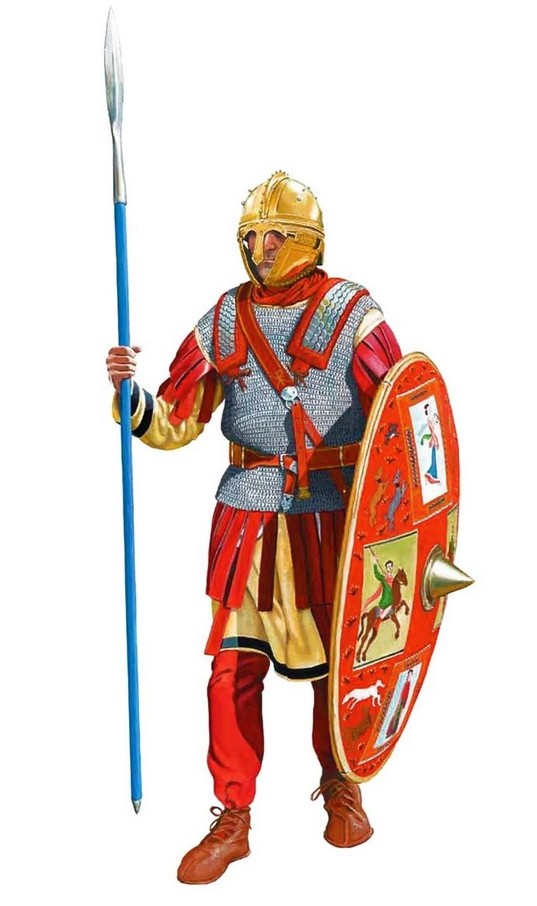
But recovery is still possible. Provincialism has not yet bred nationalism. The Gallic National Empire is a great failure, and raises no spirit contrary to Latin civilisation. In the end there is only one solution. The big provinces, all Imperial by now, and the legions must be divided, while bureaucracy multiplies. When order is restored, the whole system is reformed thoroughly by Diocletian, and Constantine continues his work. Reduced to one thousand strong, the legions are redistributed all over the Empire, though some portion of the old unit is usually retained in its old quarters. The frontier garrisons are left where they are; but they are legally tied to the spot, and not allowed to desert the service. Frontier guard-duty becomes a hereditary trade. A principle begun in the second century comes into wide use in the fourth, and the frontier corps are supplemented by new drafts of unfixed number, enrolled en masse from tribes outside the Empire. So in its last brilliance the Empire revives the old solution of the moribund Republic. These barbarian troops, mixed with drafts from the legions, come to form an Imperial field force. But how long will the Empire stand the strain? It has to assimilate these foreign elements and make them good and loyal citizens. Again, by the end of the century, all the high army commands are passing to Teutons, and Teuton troops make up the army list of Honorius on an alarming scale. Half is provincial, and half utterly non-Latin and barbaric. Nor is the outside world slow to perceive this change. Between the quarrels of the Imperial House, the treachery of provincial governors, and the eager press of external nations to enter the lucrative and gorgeous Imperial Service, the Empire is reeling. By the opening of the fifth century an external King like Alaric is asking for a share in the Empire, and receives the dignity of Master of the Horse, vindicating his claim by taking Rome. Stilicho, himself a Vandal, is not exempt from sus- picion of collusion. Only a push is needed, and the whole top-heavy structure will fall. Presently the long expected disaster comes the great wave of Huns, the worst invasion Europe has had to face for centuries, sweeps into the west. It is broken at Châlons, by the united Roman and Visigothic armies. But the recoil is as disastrous as the blow; it disturbs all Central Europe, already in a ferment, and the West-Roman Empire comes to an end amid a welter of folk-wanderings.
___________________________
[1] But love gives birth to hubris. (ed.)





I’m not sure if this website is defunct, but if it disappears one day, I hope you and the rest of the men who posted on here know that it was greatly appreciated. There were a lot of good articles and insights that I use even today. I still have (and enjoy) my MOTW shirt, by the way. Take care.
Hey Buddy, I suppose we are just on an extended hiatus. We had some regular contributors who could not lnoger do so, and we have all just been busy on other endeavors. I would bet that we would see it all ramp back up at some time. If you ever have something to contribute, let us know.
Thank you for the kind words. Keep you chin up. God’s still in charge.
Amen. I’ve been pretty busy myself with building something substantial in my community, so I understand. I’m not sure that I have anything terribly substantial to offer for an article, but I appreciate your offer.