
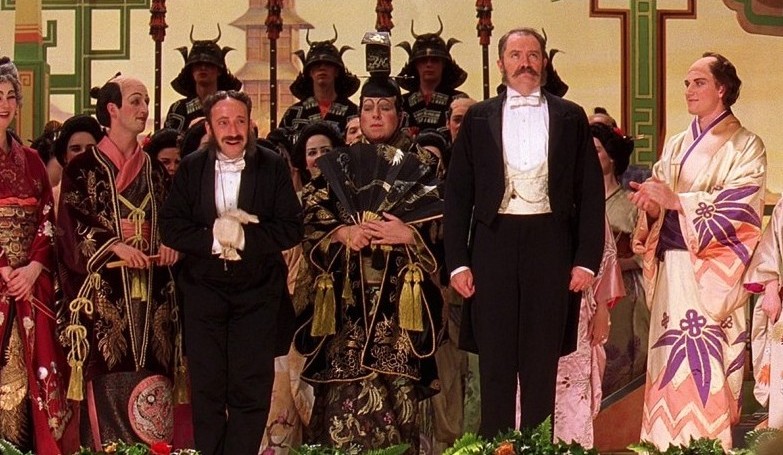
Concerning Gilbert and Sullivan’s impact on the English stage, H. M. Walbrook wrote:
They came at a psychological moment—an hour when English Comic Opera had practically ceased to exist. London had Offenbach, Lecocq, Audran, Hervé, Von Suppé, Planquette; and very cheerful and tuneful they were; but their necessarily bowdlerized libretti were generally crude and frequently unintelligible, while an admitted attraction of many of these continental importations lay in the suggestion that, in the matter of the ladies’ dresses, the management had gone on the principle of “doing as little as possible and doing it well.” In the place of all this foreign melody and meretricious charm, W. S. Gilbert and Arthur Sullivan gave us a genuine English article, satirical, but at the same time loyal to the average general English sentiment; witty beyond anything of the kind known here before; humorous, with the tear, here and there, not far removed from the laughter; clean to ear and eye, and set to the sort of music the English people most love and best understand, namely, that of the ballad, the madrigal and the dance.[1]
In Topsy Turvy, writer-director Mike Leigh does justice to these remarks by giving us the origin story of The Mikado, one of G&S’s best loved operas.
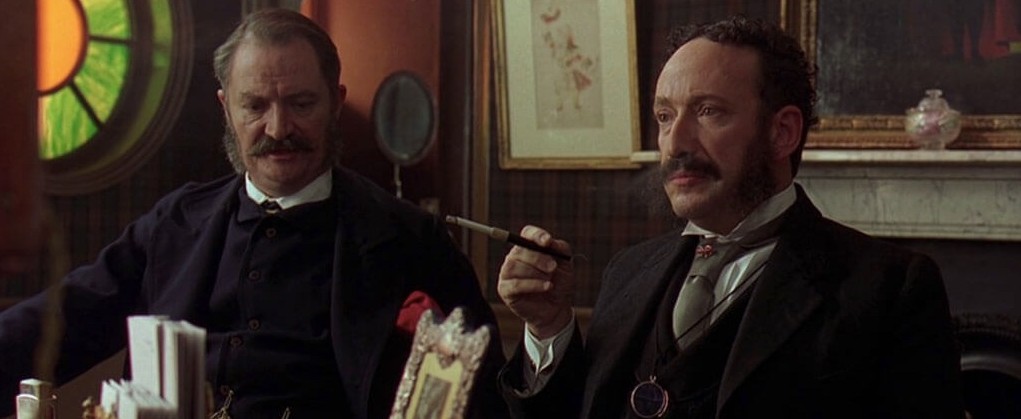
The film opens in 1884 with the celebrated duo creatively spent and at loggerheads with each other. Librettist W. S. Gilbert (Jim Broadbent), stung by a critic’s damning-with-faint-praise review of Princess Ida, labors vainly to devise an original plot for their next production. Composer Sir Arthur Sullivan (Allan Corduner), physically ill and weary of the musical limits imposed by Gilbert’s light comedic writing, announces his intention to end the collaboration and strike out on his own. Producer Richard D’Oyly Carte (Ron Cook)—whose Savoy Theatre was purpose-built to house G&S performances—reminds the partners tactfully that they are under contract. He nevertheless grants Sullivan a sabbatical to recuperate and reconsider. In the meantime, the Savoy reruns an earlier work, The Sorcerer, to keep seats filled.
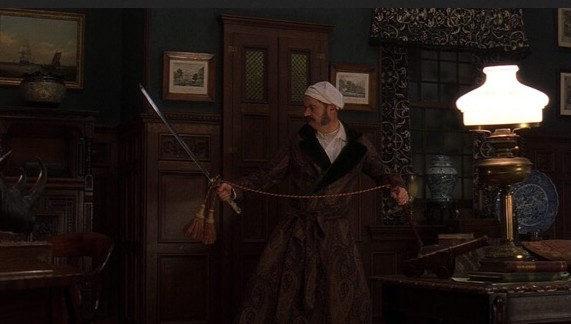
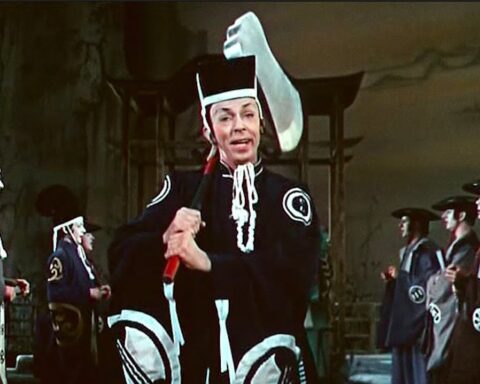
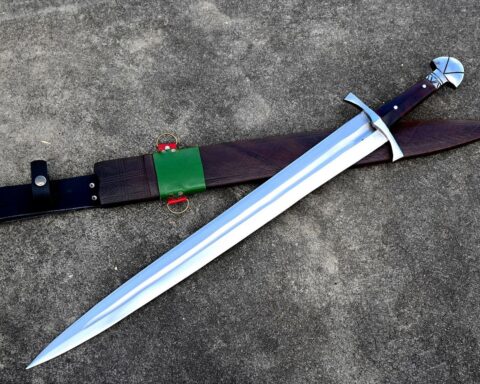
Gilbert attends a Japanese cultural exposition in Knightsbridge, where he observes a Kabuki play with intense fascination and purchases a souvenir katana to display in his study. When the sword falls from its mounting, he draws the blade and brandishes it like a samurai before sheathing and laying it on a pile of books. He regards it thoughtfully. Then his face lights up with sudden inspiration as we hear the opening heraldic notes of “Behold the Lord High Executioner”. The film transports us instantly to a stage performance of this song from Act I of The Mikado—and into that realm of keen satire fused with exuberant melody, where the Japanese crown prince Nanki-Poo, disguised as a wandering minstrel, seeks the forbidden hand of his lady love, Yum-Yum. This is one of many deft segues whereby Leigh solves a key structural problem of the story (how to balance depictions of the opera’s making with selections of the finished product), and impresses upon us the magnitude of the artistic advance beyond The Sorcerer. Preposterous as its subject—the elevation of a petty convict to the rank of dread magistrate—may be, “Behold” in its playful genuflections is a far more engaging and powerful work than all the hideous conjuring of “Sprites of Earth and Air.”
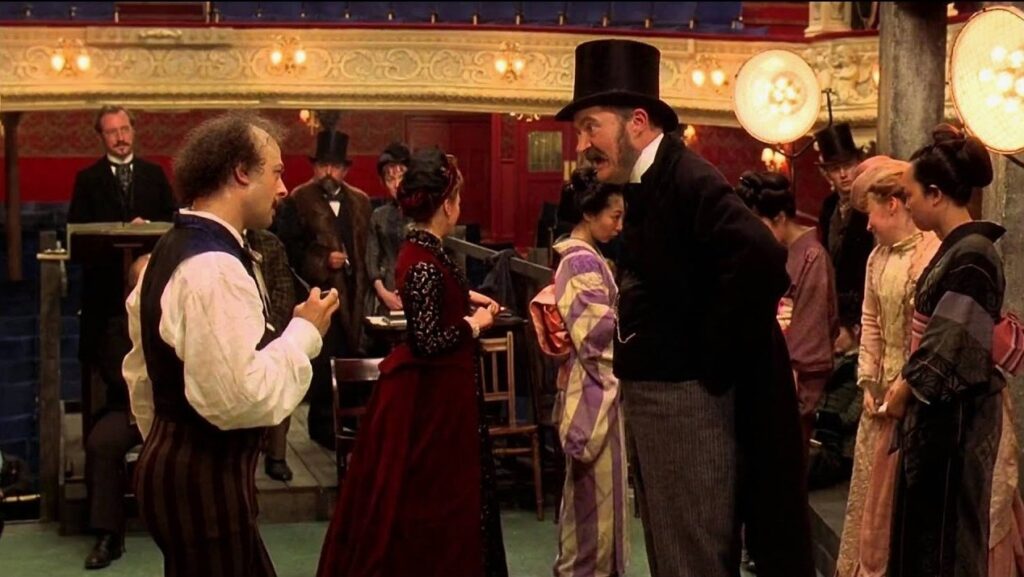
Sullivan, drawn by a tale with broad human scope, returns to the partnership, and the remainder of the film devotes itself to the painstaking craft and labor of bringing the opera to life. We see G&S’s attentiveness to every detail in their respective spheres. Costumes are tailored to meet a standard of authenticity. Japanese ladies are brought in to teach British actresses how to walk and hold fans properly. Rehearsal, the grueling process of repetition and refinement, commences on stage, around Sullivan’s piano, and in the orchestra pit. Carte adroitly manages a stable of vain, recalcitrant, or addicted performers with a judicious combination of incentives and politely worded threats.
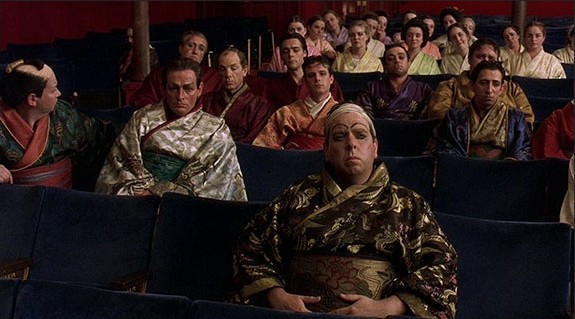
Indeed it is through the struggles of the performers themselves—with the material and their personal failings—that Leigh reveals the true heart of theater. The dressing room gossip and backstage banter, arguments with the director and fussing over unfamiliar costumes, while seemingly petty, here express something essential about great works of the stage: they are made by flawed and even broken people, surmounting inner limitations to grapple with the conceptual and technical demands of an art form. Every actor and singer in the film, from the celebrated principals to the backmost row of the chorus, is a dedicated professional. Gilbert’s acknowledgement of this goes beyond mere courtesy; he relents when the assembled cast petitions him to restore a song (“A More Humane Mikado”) he’d cut from Act II.
The Muses likewise exact a toll from the writer and composer. Gilbert pours passion into his libretti, leaving not a drop for his marriage. Sullivan drags himself in torment from a sick bed to the conductor’s podium, as if music were his master and not the reverse.
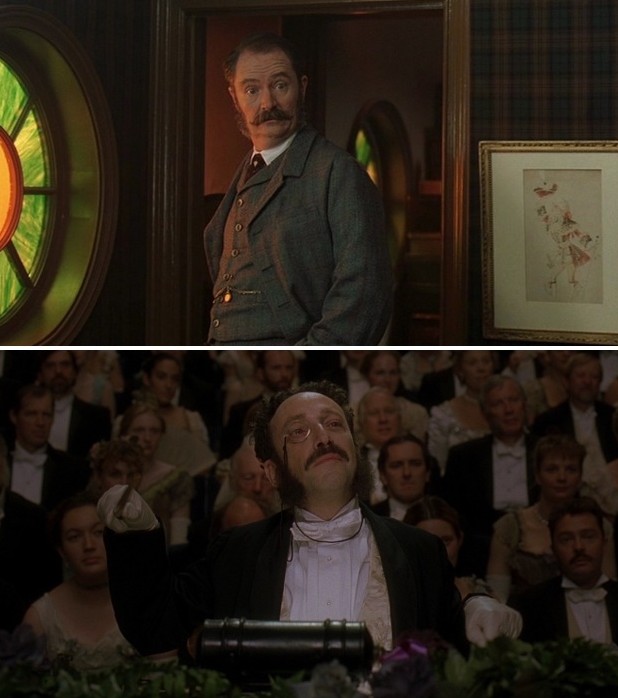
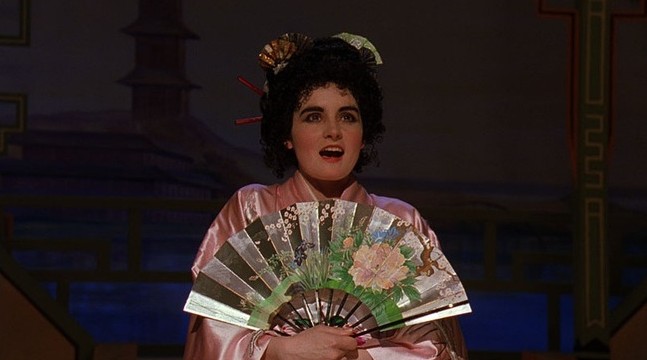
Performances in the film are fine throughout, with Broadbent and Corduner ably portraying the contrasting, complex personalities of the lead roles. Cook as Carte embodies authority and self-restraint, supported by an equally firm right hand (Wendy Nottingham as Helen Lenoir, his business manager). Martin Savage (George Grossmith/Ko-Ko) and Kevin McKidd (Durward Lely/Nanki-Poo) convey admixtures of neuroticism and self-importance with sureness of talent. Shirley Henderson as Leonora Braham/Yum-Yum plays her role with particular acumen, by turns intense and vulnerable, asking no quarter from a hard life, and delivering a memorably fierce rendition of “The Sun Whose Rays Are All Ablaze.”
Honorable mention goes to Andy Serkis as choreographer John D’Aubon, whose disturbing locomotion recalls that of a predatory water bird.
______________________
[1] Gilbert & Sullivan Opera, A History and a Comment (London: F. V. White & Co., 1922)



I have seen this wonderful film on several occasions. Great performances, costuming etc. Just perfect.