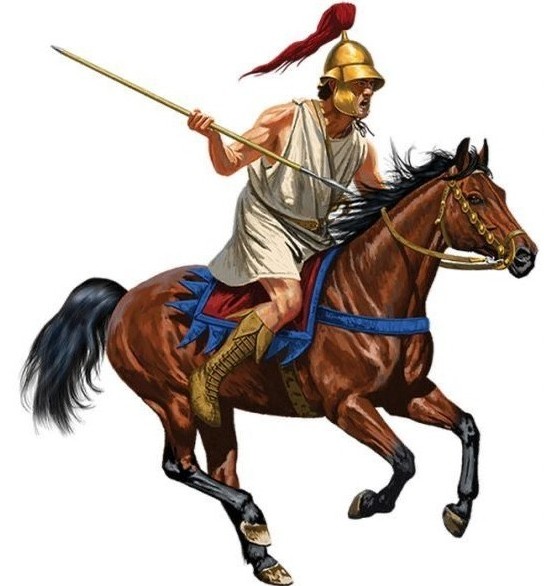
Editor’s note: The following is extracted from The Horse in History, by Basil Tozer (published 1908).
It seems practically beyond dispute that before the year 1000 B.C. no people rode on horseback except the Libyans, though chariots must have been used quite 2000 years before that. Yet by the time Homer wrote his poems horsemanship was becoming common amongst a section of the Greeks.
Indeed by that time feats of skill on horseback upon a par with the antics we see performed today in circuses were at least known, and probably they were often watched and greatly liked. Listen, for instance, to the following Homeric simile — the translation is almost literal : —
“As when a man that well knows how to ride harnesses up four chosen horses, and springing from the ground dashes to the great city along the public highway, and crowds of men and women look on in wonder, while he with all confidence, as his steeds fly on, keeps leaping from one to another.”
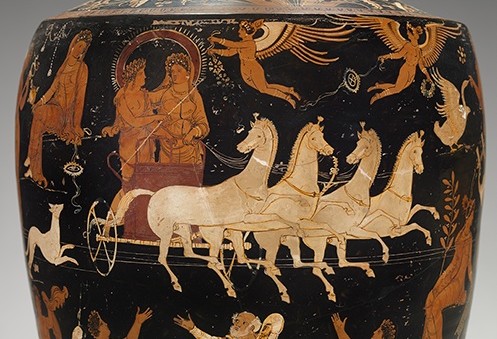
There are two references at least in Homer to “four male horses yoked together,” but the practice of driving four-in-hand certainly was not common in the eighth century B.C., or probably until long after. The above reference, however, to feats of skill performed on horseback, recalls to mind a story, probably more or less true, that has to do with the luxurious people of Sybaris, in Southern Italy.
In the early centuries before Christ, so it is related, this people trained all its horses to dance to the sound of music, to the music of flutes in particular. The inhabitants of Croton having heard of this, and being sworn enemies of the Sybarites, determined to take advantage of the information and attempt to conquer their foe with the aid of strategy.
For this reason they provided all the musicians in their own army with flutes in place of trumpets and the other instruments they had been in the habit of using, and then without delay declared war upon the Sybarites.
The latter, to do them justice, responded at once, in spite of the condition of lethargy to which the life of luxury they had been leading was supposed to have reduced them. No sooner did they approach the Crotonian lines, however, than ” a great part of the army,” as we are told, “set up a merry tune,” which had the effect of stampeding the Sybarites’ horses, for “they instantly threw off their riders and began to skip and dance.”
As a natural consequence the Sybarite army was taken at a disadvantage and quickly routed with great slaughter, “very many horses being killed during the engagement, to their owners’ dismay and grief.”
This strange story may be in a measure exaggerated, but probably it is based on truth, in which case it proves that the Greeks of Magna Graecia at any rate made use of cavalry before the rest had attempted to do so. Also we know that in the year 510 B.C. the Crotonians destroyed Sybaris entirely.
The Assyrians too, at about this period, evidently had well-appointed cavalry, for Ezekiel speaks of their being “clothed in blue, captains and rulers, all of them desirable young men, horsemen riding upon horses,” and goes on to give particulars which, in so far as they relate to the mode of life in vogue with these desirable young men, are calculated to shock the susceptibilities of prudish persons, and to amuse others.
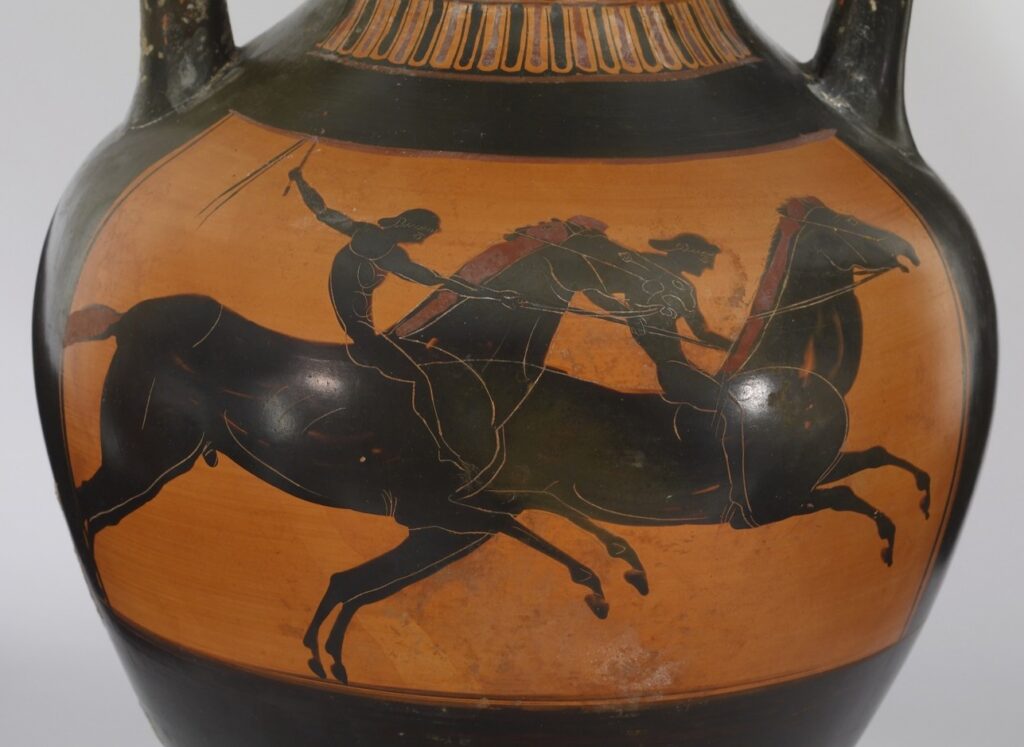
In the light of the Higher Criticism Homer’s “Iliad” is believed to have been written by various hands, and incidentally the Criticism throws useful light upon the horse in his relation to the history of the nations known to have flourished in the very early centuries before Christ. One need not here describe such steeds as Agamemnon’s mare, swift Æthe, that was given to him by his vassal, Echepolus of Sicylon, and subsequently driven in the chariot race by Menelaus ; or Phallas, the horse of Heraclios ; or the horses of the Pylian breed of which Homer speaks at length ; or Galathe, Ethon, Podarge or any of the other steeds of which Priam’s eldest son, ” magnanimous and noble Hector,” was so justly proud. Also the horses of mythology do not possess great interest for the majority of modern readers other than classical scholars.
That Homer himself, however, had sound knowledge of the qualifications which go to make up what in latter-day English we probably should term a “finished charioteer” is shown by the following rather well-known lines that here are translated almost literally: —
“But he who in his chariot and his steeds
Trusts only, wanders here and there
Unsteady, while his coursers loosely rein’d
Roam wide the field ; not so the charioteer
Of sound intelligence ; he, though he drive
Inferior steeds, looks ever to the goal
While close he clips, not ignorant to check
His coursers at the first, but with tight rein
Ruling his own, and watching those before.”
Menesthus, emphatically one of the finest of the many fine riders spoken of in the “Iliad,” or, as Homer himself describes him, “foremost in equestrian fame,” is typical of the horsemen of that period. In the “Iliad” too we find what I believe I am right in stating to be the first direct historical allusion to wagering on horse races. But the medium current on racecourses in those days was not coin. The odds apparently were laid in “kitchen utensils” — as a lad with whom I was at school once construed the line, to his subsequent discomfiture—namely, cauldrons and tripods.
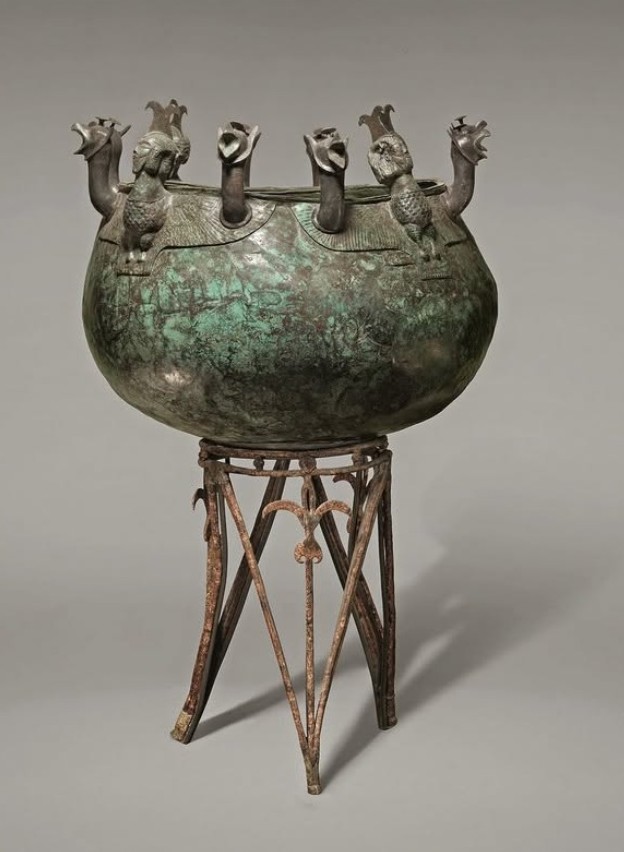
Such, at least, we are led to infer from the paragraph in the twenty-third book of the ” Iliad,” which, according to William Cowper’s blank verse translation, edited by Robert Southey, runs somewhat as follows : —
“Come now — a tripod let us wager each,
Or cauldron, and let Agamemnon judge
Whose horses lead, that, losing, thou mayst learn.”
Or more euphoniously, as Lord Derby has it :
“Wilt thou a cauldron or a tripod stake
And Agamemnon, Atreus’ son, appoint the umpire
To decide whose steeds are first?”
The cauldrons and tripods referred to were of course of great value, and, as trophies, highly prized by competitors in the races and other competitions calling for a display of skill and daring.
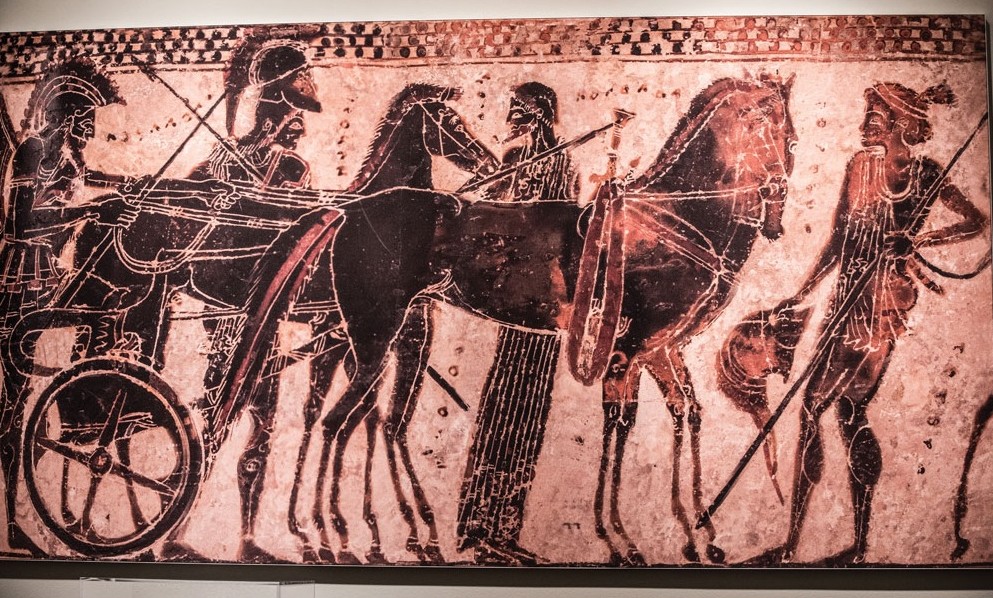
There is another allusion in the “Iliad ” to the presentation of a tripod as a great reward for valour. It occurs in the eighth book, and the passage goes more or less like this :
“Let but the Thunderer and Minerva grant
The pillage of fair Ilium to the Greeks,
And I will give to thy victorious hand,
After my own, the noblest recompense,
A tripod or a chariot with its steeds,
Or some fair captive to partake thy bed.”
I recollect how at school this passage, with several others, used to be rigorously excluded when Homer was being construed, with the result that Kelly’s famous “Keys to the Classics” used afterwards to be produced surreptitiously, and the “censored” lines turned carefully into English.
From what Homer tells us elsewhere, and from additional sources, we may conclude that of all the races that bred horses and took just pride in them in the early centuries before Christ the Thracians were probably the most renowned.
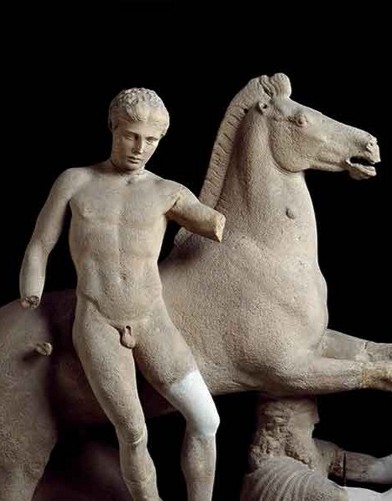
The brilliant horsemanship of “noble Patroclus of equestrian fame,” the amiable and staunch friend of Achilles, must not be passed unmentioned ; nor the deeds of prowess that are attributed to Euphorbus, “famous for equestrian skill, for spearmanship, and in the rapid race past all of equal age” ; nor yet the deeds of Hyperenor whose skill in handling horses may be likened to the skill of Rarey in our own time.
The following lines from the “Iliad” are of interest here because they serve to indicate to some extent the style of harness and useless trappings that must have been in vogue amongst the wealthy in Homer’s day : —
“So Hera, the goddess queen, daughter of great Cronos, went her way to harness the gold-frontleted steeds ; and Hebe quickly put to the car the curved wheels of bronze, eight spoked, upon their axletree of iron.”
Then : “Golden is their felloe, imperishable, and tires of bronze are fitted thereover, a marvel to look upon ; and the naves are of silver, to turn about on either side. And the body of the car is plaited tight with gold and silver straps, and two rails run round about it.”
And a silver pole stood out therefrom ; upon the end she bound the fair golden yoke, and set thereon the fair breast-straps of gold, and Hera led beneath the yoke the horses, fleet of foot, and hungered for strife and the battle-cry.”
It has been argued that about the time of Homer gold and silver were deemed to be comparatively of small value, and that therefore the trappings described were not so costly as one naturally would conclude they must have been.
Upon this point opinions are about equally divided.
Professor Ridgeway tells us that by comparing the foregoing description with actual specimens of chariots and horse trappings that have been found in Egypt we can form an accurate impression of the appearance that was presented by the original old chariots, and form also an idea of the way they were put together, while the plaiting with straps of gold and silver recalls at once the floor of the Egyptian chariot with its plaited leather mesh work — probably the forerunner of leather springs.
Though Odysseus and Diomede are known to have mounted their Thracian horses, we have it on irrefutable evidence that at this period chariots were still generally used, so that most likely horses were ridden but seldom.
Indeed the Homeric poems provide us with probably as much authentic information as to the methods of managing and breeding horses that were in vogue in Greece, in Thrace, and in Asia Minor in the very early years before Christ, as any half-dozen other volumes put together that purport to deal with the ways and customs of a period of which, when all is said, little enough is known.
Naturally the Thracians had in those days some of the best horses that could be procured, while those they drove in their war chariots are said to have been quite unrivalled. That they possessed very many chariots is proved by Homer’s realistic account of the slaying of Rhesus, the Thracian king, with a dozen or so of his bravest followers, and the episode in connection with that incident.
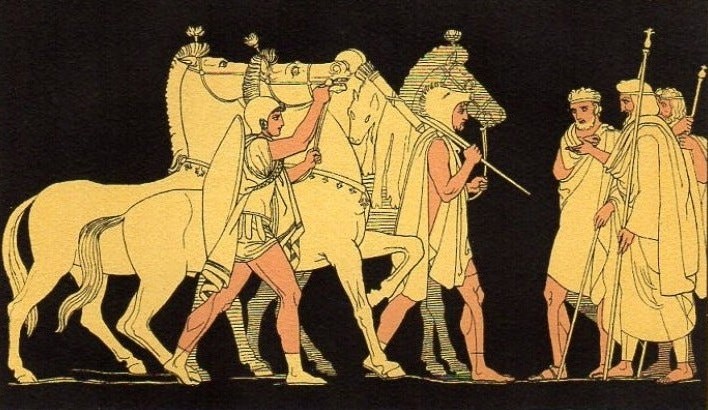
Indeed when Odysseus and Diomede had captured Dolon, the Trojan spy, the latter at once declared that there were “also Thracians, new-comers, at the furthest point apart from the rest, and amongst them their king, Rhesus, son of Eioneus,” adding that his were “the fairest horses that ever I beheld, and the greatest, whiter than snow, and for speed like the winds. His chariot too is fashioned well with gold and silver, and golden is his armour that he brought with him, marvellous, a wonder to behold.”
Apparently most of the horses bred by the Acheans at about this time were either dun-coloured or dapple. Xanthos signifies Dun, and balios dapple ; but then we have to remember that xanthos was used frequently to denote also the colour of gold.
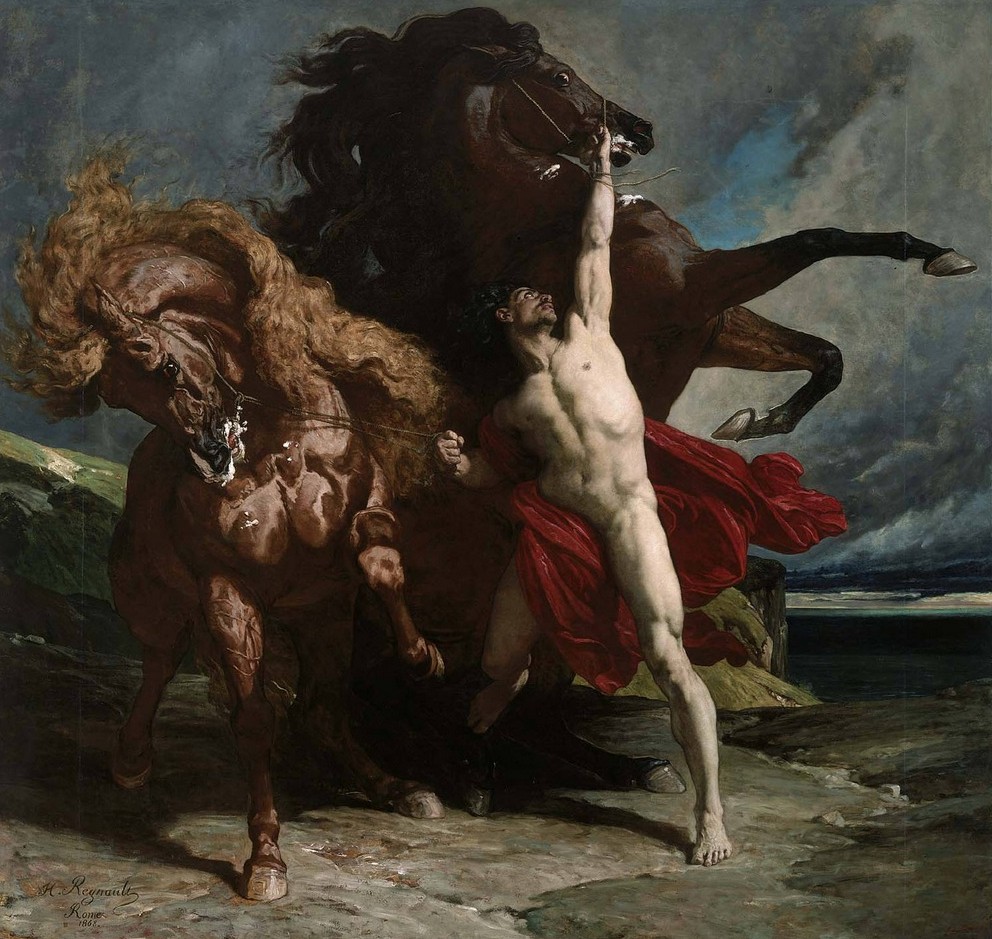
Achilles’ steeds were mostly dapple-dun, and they had more or less heavy manes. They belonged most likely to the breed so popular among the Sigynnae of central Europe about the fifth century B.C. Certainly Homer makes it plain that in the early Iron Age horses were bred in many parts of Greece ; that, though driving was a common practice, riding was indulged in but rarely; that cavalry in battle was quite unknown ; and lastly that though the heroes, as they were called, fought mainly in chariots, the great body of the army consisted of well-trained infantry.
As time went on horsemanship apparently came to be appreciated more and more, for we read that about the year 648 B.C.—the thirty-third Olympiad— “a race for full-grown riding horses” was inaugurated in addition to the chariot races, and there appear to have been plenty of entries. Then though the war chariot had disappeared almost completely, before the outbreak of the Persian Wars, its place was not taken by well- appointed and well-equipped cavalry until some years later.
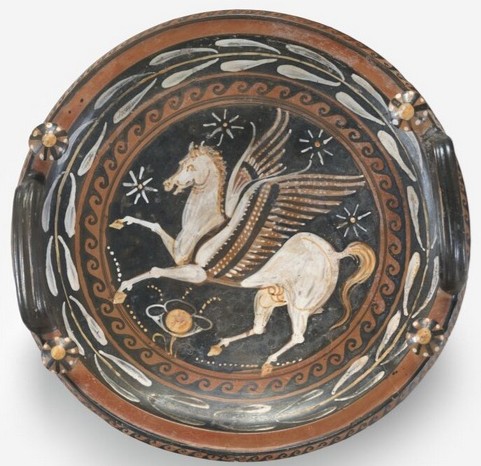
Though little attention need be paid to the Greek legend that Pegasus was the first horse ever ridden—a legend not mentioned in Homer—it nevertheless is interesting to know that this historic animal was supposed to have been foaled in the Bronze Age, and in Libya. That naturally would have been prior to the arrival of the fair-haired Acheans from Central Europe, so one need not be astonished, as several writers obviously are, at finding that when these large-limbed Acheans first appeared the Greeks already knew how to ride.
At the same time they seldom did ride their dun-coloured little cobs, preferring, apparently, to drive them in pairs in chariots. That the Libyans were finished horsemen centuries before the Greeks learnt how to ride has already been mentioned ; though whether or no the Greeks were first taught horsemanship by the Libyans is a question still debated by students of ancient history.
In the north-west of Asia Minor the Libyans had dark bay horses with a white star upon the forehead about the year 1000 B.C., and a hundred or so years later horses of this breed were largely imported into various parts of Asia Minor.
Indeed some of the more enthusiastic of the modern historians who have studied closely the descent of horses from generation to generation persist in maintaining that even in Great Britain and Ireland modern horses with this white star upon the forehead have in their veins some Libyan blood! How this can well be when we know almost without doubt that until towards the close of the Bronze or the beginning of the Iron Age the horse was hardly made use of at all by the inhabitants of these islands, I leave it to more learned men to decide among themselves.
It is remarkable that whereas from very early times horses of Asiatic- European breeds have proved more or less unmanageable except when bitted, the horses of Libya are known to have been controlled quite easily by nosebands only. Some of the nosebands, or rather halters, used in early times were made of plaited straw, and today halters of almost similar make and pattern are still employed in certain of the more remote parts of Ireland.
The bits found most suitable for Asiatic-European horses were made first of all of horn, then chiefly of bone, later of copper, and finally of bronze and iron. Homer, in his “Iliad,” alludes to bits of bronze placed between the horse’s jaws, and this probably is one of the first instances of literary evidence we have that a thousand years before Christ’s birth horses were controlled by bits.
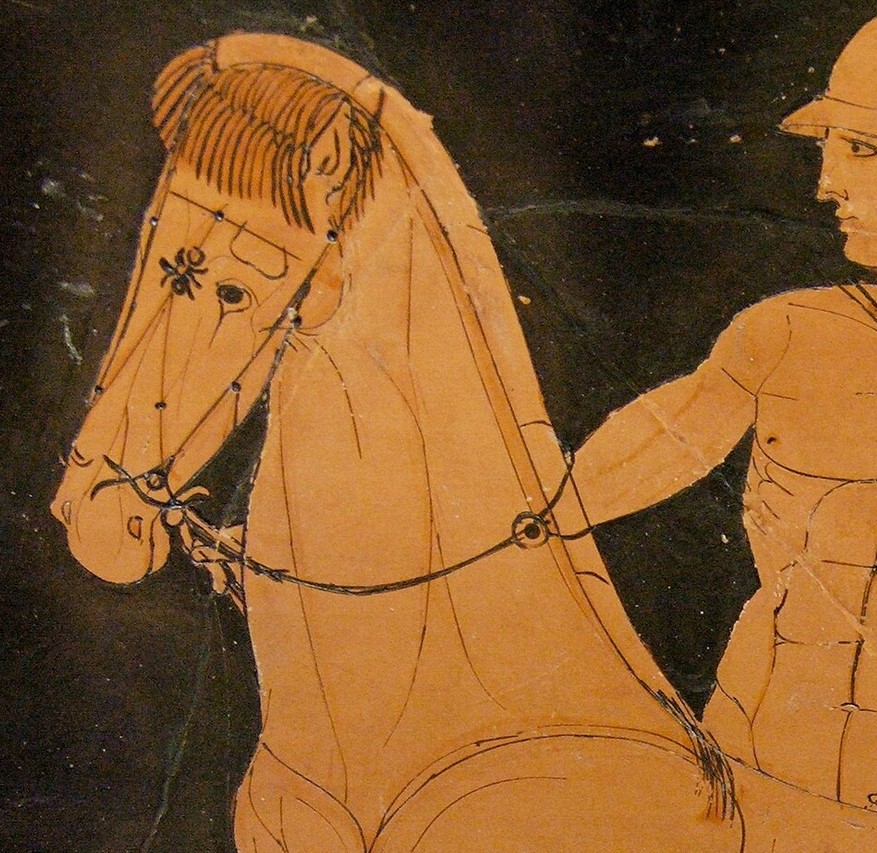
Of course Xenophon has much to say upon the question of bits and bitting, and his capital treatise on horsemanship throws valuable light also upon the horse in its relation to the history of that epoch, as we shall see. Upon one point in particular in this connection Xenophon lays great stress. He maintains it to be imperative that every horseman shall possess two bits for his horse or horses, one with links of moderate size, and one with sharp and heavy links, bidding us at the same time remember that “whatever sorts of bits be used, they should be flexible, for where a horse seizes a rigid bit he has the whole of it fast between his teeth . . . but the other sort is similar to a chain, for whatever part of it be taken hold of, that part alone remains unbent—the rest hangs.”
So that apparently bits single- and double- jointed, and therefore flexible, were used in the early Iron Age by the people of North-Western Europe.
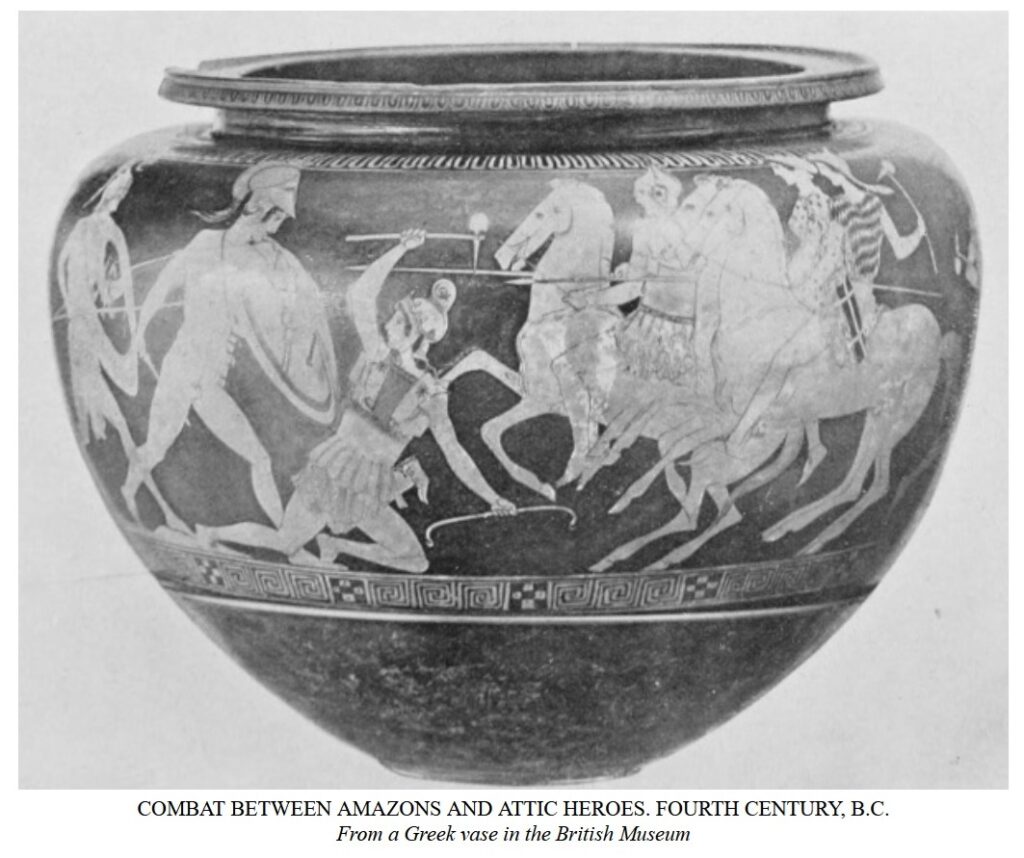
By the beginning of the fourth century B.C. many, though not all, of the Greek and the Macedonian mounted soldiers had come to consider some sort of covering for the horse’s back to be necessary to their equipment ; and so long previously as the eighth century B.C. horse cloths had been adopted by the Assyrians, a people sufficiently wise to realise from the first that a horse with something on his back is more comfortable to sit upon than one without.
These early races probably would have employed cavalry several centuries sooner than they eventually did, but for the difficulty they experienced in arming themselves to their complete satisfaction when mounted. Such peoples, for instance, as the Egyptians, the Assyrians, and the Greeks of the Mycenean or Bronze Age, habitually protected themselves with the aid of large and oblong shields when they fought on foot, but on horseback these shields proved cumbersome. Possibly that was the reason that when the Normans and other Teutonic races began to fight on horseback they so soon discarded their round and clumsy shields in favour of a shield broad at the top and tapering downward, the shape of shield we see on the Bayeux tapestry.
With regard to the war chariots in use before this time, we may be quite sure that even the very first employed had not wheels cut from solid blocks as some are represented as having, though possibly the most primitive of the agricultural chariots were so constructed.
For the rest, the early chariots of the Egyptians of the eighteenth dynasty, and in use in India under the Vedic Aryans, and amongst the Hittites, the Assyrians, the Persians, the Libyans, the Mycenean Greeks, the Homeric Acheans, the Gauls of Northern Italy and in Gaul itself; also among the ancient Britons and the early Irish, had wheels with a hub, a felloe, and spokes, the latter from four to twelve in number. And inasmuch as this information bears indirectly upon the horse in his relation to early historical records, it is not out of place here.
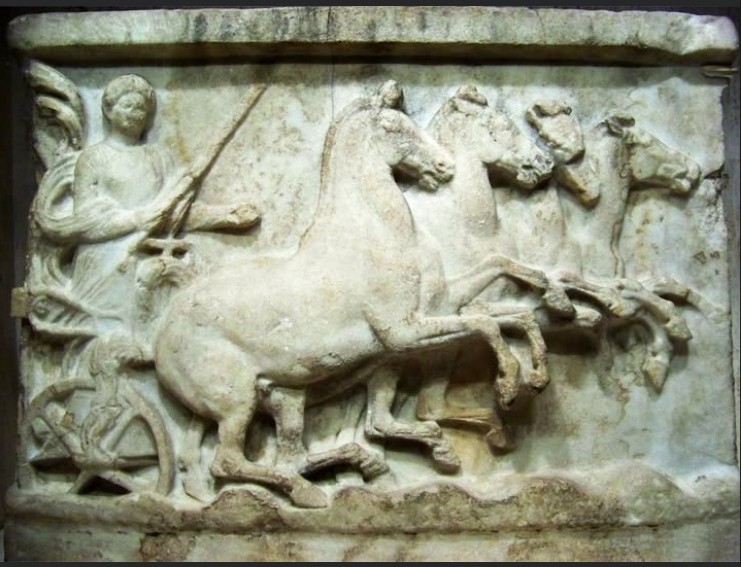
To return again to the question of harness, we have it on the authority of Herodotus that “the Greeks learned from the Libyans to yoke four horses to a chariot,” and we know already that before the time of Herodotus, who wrote in the fifth century B.C., the Greeks had found Libyans riding astride horses and driving sometimes two-horse and occasionally four-horse chariots. At that time—about 632 B.C.—the Greeks were planting Cyrene.
White horses were in ancient days at all times largely in demand among the people of the various nations ; and while Pindar alludes incidentally to white horses being ridden by the Thessalians in his time, Sophocles, writing half-a-century or so later, describes a Thessalian chariot that was drawn by white horses.
One of the regions in which white horses were bred, probably in great numbers, was the banks of the Caspian where the River Bug flows from it, for Herodotus states clearly that “around a great lake from which the River Hypanis (called now the Bug) issued, there grazed wild white horses.” Those particular animals possibly may have been in reality only tarpans in their winter coats, and not actually horses. The point has been argued more than once, but has never been quite settled. A white horse famous towards the close of the fifth or early in the fourth century was Kantake, of the notorious Prince Gautama, but nothing need be said about it here, trustworthy records being unprocurable.
The great cities of Magna Graecia—Sybaris, Tarentum, Croton, and so on—obviously had formidable cavalry in the sixth century B.C.; Sicily and Southern Italy being almost equally renowned for the riding horses obtainable there. The stratagem to which the Crotonians had recourse in 510 B.C. to bring about the fall of Sybaris has been described, and it is said that for some years prior to the destruction of the city some five or six thousand of the inhabitants were in the habit of riding in procession on horseback upon the occasions of the great festivals held there.
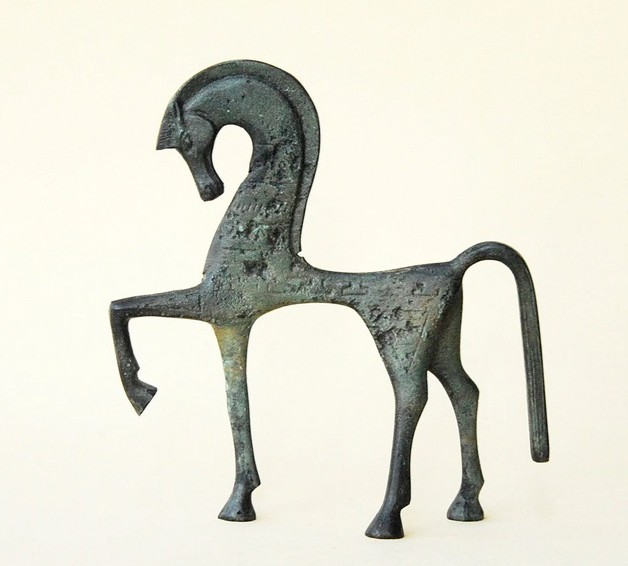
As we gradually approach the time of Christ we find increasing interest being taken in horses by the kings and great chiefs of different countries, for the value of cavalry in war was now quickly becoming manifest.
In the early days of the Homeric or Iron Age the Celts of Noricum and the Danube, though still retaining chariots, had begun to ride on horseback, and by the third century B.C. these Celtic tribes already possessed well-trained and very formidable cavalry. As a natural result the demand for still better horses grew steadily, and soon it became common to import horses into the Upper Balkan, and countries beyond the Alps, from the Mediterranean area.
Perhaps the best description of a chariot race at Delphi is to be found in the Electra of Sophocles—Sophocles flourished in the third century B.C. At about the same period Herodotus tells us that the Sigynnæ, the only tribe north of the Danube that he mentions by name, had “horses with shaggy hair five fingers long all over their bodies.” These horses were “small and flat-nosed and incapable of carrying men, but when yoked under a chariot were very swift.”
Consequently the natives drove them largely in chariots.
Though Herodotus does not allude to the colour of these small, flat-nosed horses, there is reason to believe that dun was the colour most prevalent at about this time. With regard to the horses of Northern Britain Dio Cassius says that two of the chief tribes—namely, the Caledonians and the Mæatæ—“went to war in chariots, as their horses were small and fleet,” while when the Gauls passed into Italy, towards the beginning of the fourth century B.C., they drove chariots but did not ride, in which respect they resembled the Sigynnæ north of the Danube.
Thucydides, writing at the end of the third century B.C., speaks with interest on the subject of horses’ hoofs, pointing out that the reason so many of the cavalry horses of the Athenians went lame towards the close of the Peloponnesian War was not that they had been wounded, as some historians have averred, but owing simply to their not being shod. This was after the Spartans had occupied Decelea and suffered their heavy loss.
Alcibiades, in the third century B.C., had many horses, and in the sixth book of “Thucydides” he tells us in his speech that he sent into the lists no less than seven chariots, adding that “no other man ever did the like”; and later he goes on to mention that he won the first, second and fourth prizes.
Apparently Alcibiades knew his world, and if so it would seem that his world was not unlike the world we know today, for in another passage he sententiously yet philosophically tells us that we “must not expect to be recognised by our acquaintance when we are down in the world; and on the same principle why should anyone complain when treated with disdain by the more fortunate?”
This particular sentence is according to the translation of “Thucydides” by the late Professor Jowett, who leaves us to infer what we please concerning the sociological views held by Alcibiades.
Among the first to employ war chariots with scythes intended to mow down the enemy were the Persians, if historical records are to be trusted, and we read that the chariots they used in the battle of Cunaxa, in 401 B.C., were provided with sharp blades, while in after years the people of Syria had war chariots with spears as well as scythes.
Thus in the bloody battle fought between Eumenes of Pergamus, and Antiochus of Syria, to mention but a single instance, Antiochus had four-horse chariots with scythes and spears in his front line of battle, whereupon Eumenes purposely “created terror” amongst these horses, with the result that they turned suddenly and dashed back into the lines of Antiochus, spreading devastation and death on all sides in their own ranks.
Certain it is that upon that occasion many horses were cut to pieces by the scythes, but for a full and graphic description of what happened I must refer the reader to the thirty-seventh chapter of the immortal “Livy.”
The esteem in which horses, especially war horses, were held in the centuries that immediately preceded the coming of Christ may to some extent be gathered from the prominence accorded to them when coins to be used as the circulating medium began to come into general vogue. Thus on the first of the Carthaginian coins—they were struck in the third century B.C.—we find represented a horse upon one side, a palm-tree upon the other, while on the coins of the important Sicilian settlement, Panormus, a horse is shown.
I have tried to disentangle from a mass of only semi-trustworthy records the true origin of the well-known saying: “He has Seius’ horse in his stable.” So far as one can ascertain, it is traceable to the fates of the various ill-starred owners of the horses of Gnæus Seius, from Seius down to Anthony. Plutarch says that the famous Philip II loved to commemorate his Olympian victories by stamping the figure of a steed upon some of his coins, and certainly he was devoted both to horses and horse racing. We read too that between 359 and 336 B.C. he entered both chariots and riding horses for the Olympian competitions.
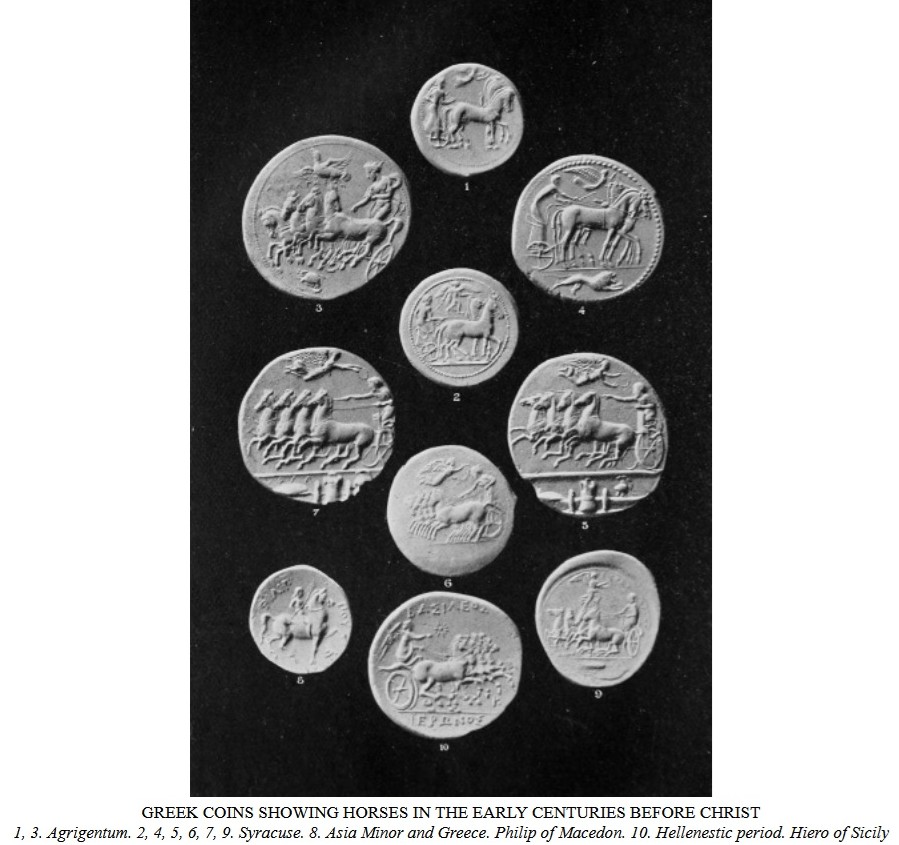
Similarly a proportion of the Sicilian coinage bore the impression of a horse, and many of the great chariot races are commemorated on coins. Several of the Agrigentine coins, for instance, show a quadriga driven by winged Nike, in commemoration probably of the victory of Exænetus, while some of the coinage of Syracuse dating back so far as 500 B.C., and even earlier, represents a four-horse chariot upon the face of the tetradrachms, and, on the didrachms, a man riding one horse and leading another. Some of the drachms show merely a man mounted.
Indeed we are told that Gela not only prided herself on her victories won on the race track, but upon what was, of course, of more importance—her splendid cavalry. A number of her coins represent a four-horse chariot, some a two-horse chariot, and occasionally a wounded foe being speared to death by a horseman, galloping or stationary. These coins probably are among the earliest of their kind ever struck.
The most ancient of all representations of Sicilian horses, however, which serve to prove that the Sicilians were beyond doubt a horse-loving race, is the quadriga on one of the metopes of the archaic temple of Silenus, believed to have been founded in 628 B.C.
While upon the subject of sculpture, casual reference must be made to the notorious Wooden Horse of Troy, described fully in Homer and alluded to centuries later by Virgil, the horse of which the famous sculptor, Strongylon, made a model in bronze towards probably the close of the fifth century.
The story of this horse hardly needs repetition, but briefly it is to the effect that soon after Hector’s death Ulysses commanded Epeios to construct a wooden horse of great size that ostensibly was to be used as an offering to the gods to please them and thus ensure a safe voyage back to Greece.
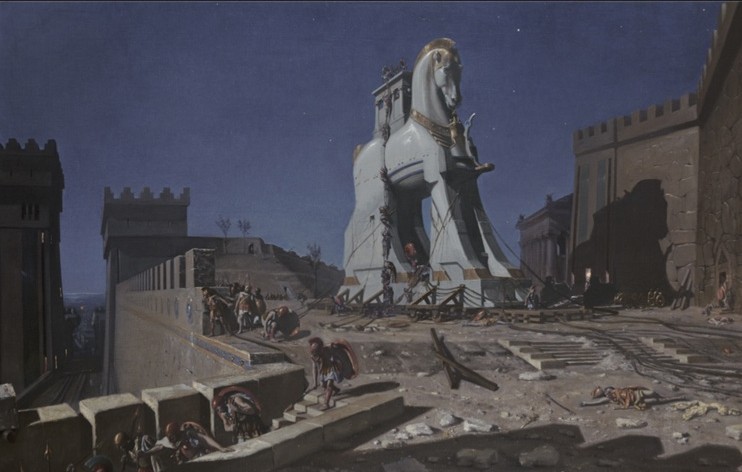
Unsuspectful of treachery, the Trojans received the great effigy and brought it into their city; whereupon, in the dead of night, the Greek soldiers hidden within it crept cautiously out, pounced silently upon the Trojan guards and slew them before they could defend themselves; then opened the gates of Troy, let in their own soldiery, and finally set fire to the city.
Menelaus is said to have been among the Greeks concealed in the wooden horse.
If evidence in addition to that already given be needed to prove that the ancient Greeks held horses in high esteem, and that the Grecian conquests were probably in a great measure due to the help afforded by the possession of horses, notice has only to be taken of the vastness of the space occupied by the Athenian cavalry shown on the Parthenon frieze.
Indeed at about this period probably no accomplishment was quite so highly esteemed as horsemanship, with the result that the wealthy classes began to pay special attention to the training their sons received in it, while treatises were published upon the art and how best it might be acquired.
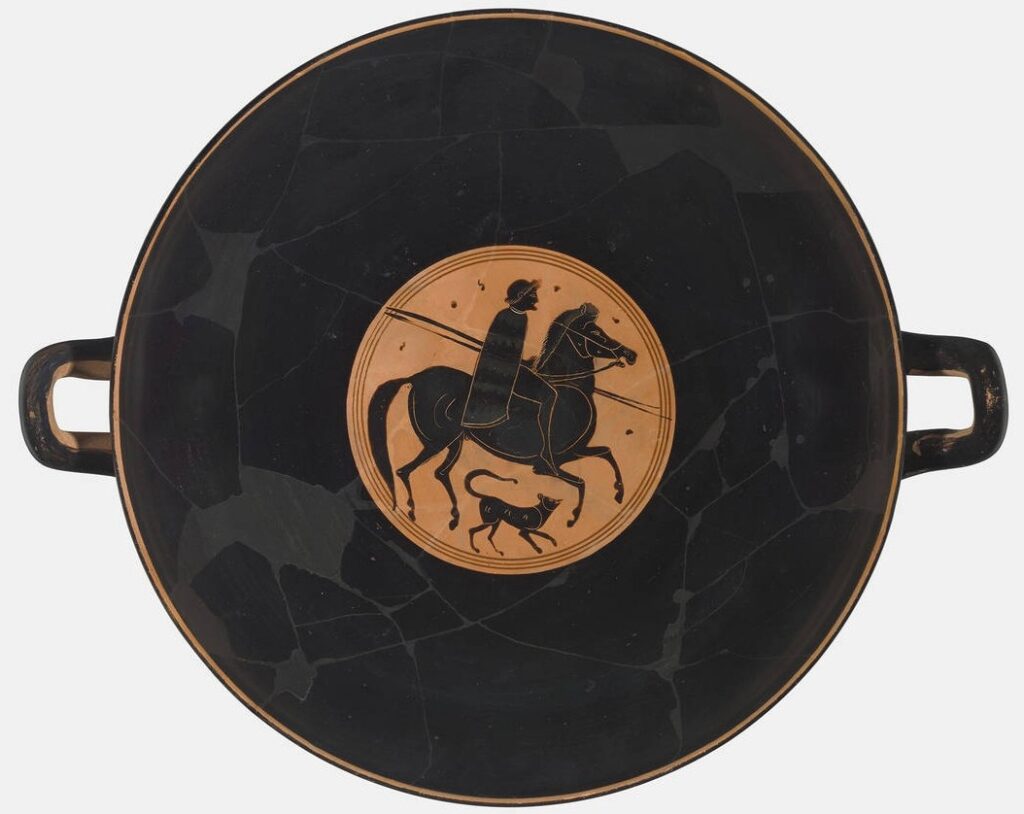
The first horsemen of whom we have indisputably authentic records invariably rode bareback, and, with the exception of the Libyans, used some sort of bit. According to Xenophon—and apparently no other historian of his time is so thoroughly to be trusted for strict accuracy—the Greeks of the fifth century B.C. were almost as fastidious upon the subject of bits and bittings as some hunting men of today are.
Some writers upon this subject have erred. Thus the impression is prevalent that the horses of the ancient Greeks were all much smaller than modern horses, and the steeds shown on the Parthenon frieze are sometimes said to afford proof that this was so. A proportion of the horses of those early times undoubtedly were smaller than the modern horse is, but on the other hand plenty were not. Probably the mistaken critics base their assertion upon the fact that the men shown on the Parthenon frieze and similar compositions, also on some of the vase paintings of that period, apparently are as tall as, or taller than, the horses beside which they are standing or on which they are mounted.
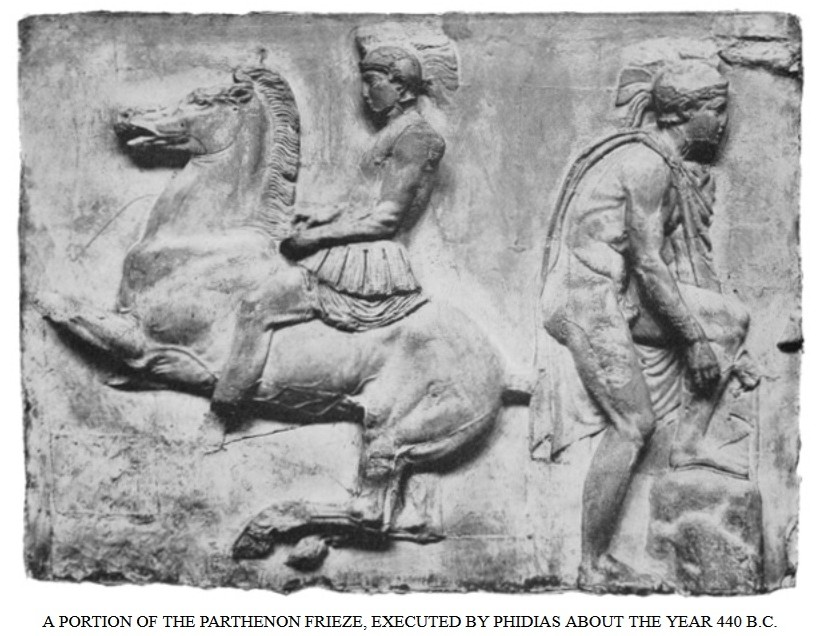
The reason men and horses are so represented simply is that according to a standard rule of ancient Greek art the heads of men and animals, and of all other figures shown on such compositions, must be as nearly as possible upon a level, even though some of the figures may be standing, some seated, some on horseback, some in chariots.
This rule, known as “Isokelismos,” is of course in direct opposition to the rule of nature, yet as it existed it had to be observed, and therefore no attempt should ever be made to compare the height of men or beasts shown in such representations as the Parthenon frieze merely by the appearance and the proportions they present. By observing how far below the horses’ bellies the feet of the mounted men hang, an approximate idea of the height of the men by comparison with that of some of their horses may be arrived at.
Herodotus is of opinion that about the year 480 B.C. finer horses were owned by the Nisæan than by any other people of Asia, and he mentions that white horses were so highly valued by the Persians of about that period—who are known to have used many white horses for sacrificial purposes—that “some three hundred and sixty horses, or about one for every day in the year, and five hundred talents of silver,” was the tribute sent by the Sicilians. This statement leads to the conclusion that white horses must have been exceptionally plentiful in the region.
That Armenia had many horses, which were largely used even so far back as the fifth century B.C., can be gathered from the writings of Ezekiel, for the prophet does not hesitate to declare that the people of Togarmah, which presumably was part of Armenia, traded in the fairs in horses and mules.
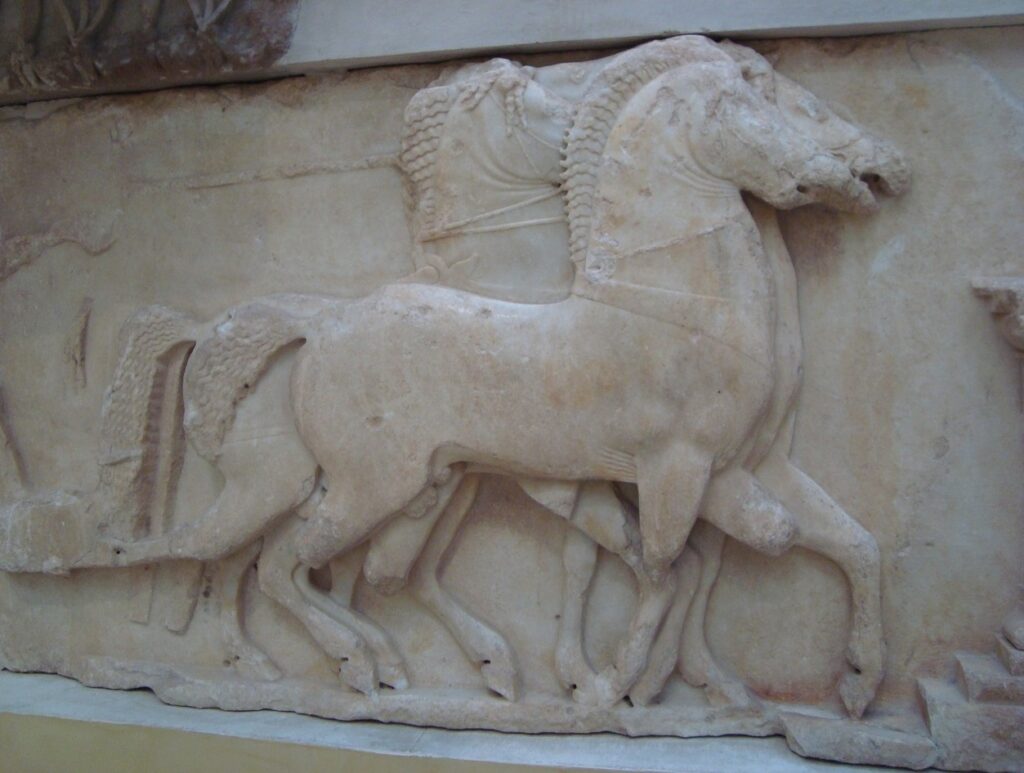
Pindar, who so glorified King Arcesilas, tells us that Cyrene became famous as the city of steeds and goodly chariots, and later the poet Callimachus sang of his home “famed for her steeds.” Hiero II of Syracuse owed practically all his great successes to the fact that he owned horses of considerable value, and to this day figures in marble of horses dedicated by him in commemoration of his victories at Olympia are to be seen in the local museum of Delphi.
Almost every year attempts are made by wealthy Americans and others to purchase some of these figures, but down to the present such attempts have proved of no avail.
Plato, again, has much to say upon the horse in its relation to the history of his epoch. Thus in one place he writes: “We must mount our children on horses in their earliest youth, and take them on horseback to see war, in order that they may learn to ride; the horses must not be spirited or warlike, but the most tractable and yet the swiftest that can be had; in this way they will get an excellent view of what is hereafter to be their business; and if there is danger they have only to follow their elder leaders and escape.”
Agrigentum—until 405 B.C., when it was destroyed by the Carthaginians—was famous for its horses. It is said that on one occasion, when one of the best-known citizens, Exænetus, won the principal chariot race at Olympus, the entire population came forth to meet him, and that he was preceded into the city by 300 chariots drawn by pairs of white horses. Indeed some of the most gorgeous monuments ever erected to the memory of famous race horses were those raised in this city during the period of its splendour.
We have it on good authority that, some centuries before Christ, the Persian men of rank deemed it derogatory to be seen on foot, and that they habitually rode on horseback. Yet in common with the people of many other races they were addicted to immolating horses on festival days, while the practices in which they indulged upon these occasions are said to have been barbarous in the extreme.
In almost every age white horses in particular would seem to have been used for sacrificial purposes. The Persians sacrificed bulls as well as horses, a bull and a horse being sometimes bound together and then immolated. Arrian mentions that one horse at least was sacrificed to Cyrus every month, the ceremony being usually performed at Pasargadea, close to the famous tomb. Here again white horses were used for the sacrifices, for among the Persians in particular the white horse was for many centuries deemed sacred and pronounced “beloved of the gods.”
One of the descriptions that probably gives a true account of a triumphal march in the third century B.C. is that of Herodotus, where he describes the procession of Xerxes. The following order, he tells us, was observed.
There came first 1000 carefully selected horsemen, then 1000 carefully selected spearsmen, then ten sacred Nisæan horses “splendidly caparisoned.” These horses were called Nisæan, we are incidentally told, because they were especially reared on the plains of Nisæa, in Media, at that period famous for its great horses.
Next came the sacred car of Zeus, drawn by eight white horses “followed by charioteers on foot holding their bridles, for no mortal was allowed to mount the seat.” Xerxes himself brought up the train, usually in a chariot drawn by Nisæan horses, with his charioteer beside him.
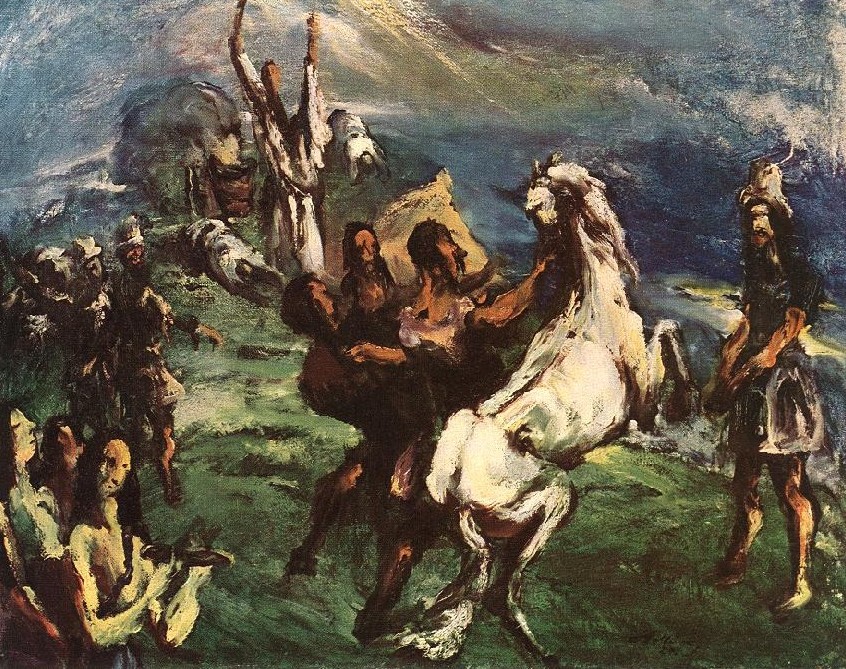
The people of almost every nation of whom we have authentic records would appear to have been addicted in the centuries before Christ to the atrocious practice of sacrificing live horses to their gods. Particulars of the weird rites observed in connection with these sacrifices are for the most part too revolting to be described here, but one practice observed by the Scythians cannot well be passed unnoticed.
This people inhabited chiefly the treeless steppes of Asia, and is known to have sacrificed animals of many kinds, but horses most of all, and usually white or dun horses.
Thus we are told that when a Scythian king died, his favourite horse, his favourite concubine, and several important members of his establishment, preferably his cook and his cupbearer, were buried with him. When a year had passed, a further ceremony took place.
This consisted in the execution, generally by strangulation, of some fifty of the strongest, handsomest and generally most desirable young men—probably young men who had belonged to his suite—and in the strangulation also of an equal number of the best horses that had belonged to him.
Then, without delay, the bodies of men and horses were disembowelled, next they were stuffed with chaff or straw, and finally when the horses, supplied each with a bit and bridle, had been set up in a circle round the tomb of the deceased monarch, the bodies of the slaughtered men were set astride them.
And there the ghastly squadron remained until it fell away to dust.
That the literary records in which these gruesome details are to be found are accurate, has to some extent been proved by discoveries made from time to time—as for instance at the opening of the great tumuli in Russia about half-a-century ago.
Indeed during the thirteenth century A.D. ceremonies equally revolting are known to have been performed regularly among the Tartars, while at the funeral of Frederic Casimir, Commander of Lorraine, in 1781, a horse was killed, and then buried with its master, and at even so recent a date as the funeral of Li Hung Chang a horse and chariot made of paper were, according to the newspaper reports, burned at the grave-side—probably a last survival of some weird rite of a sacrificial nature observed formerly in China and Japan.
Another race known to have immolated live horses, especially white horses, was the Veneti. This people lived at the head of the Adriatic, and their name survives to this day in “Venice.”
The sacrifice of white horses was common too amongst the Scandinavian and the Teutonic races, and formed part of their religion. The Sicilian Greeks, again, are said to have set a high value upon white horses, and to have sacrificed them under the impression that by doing so they afforded additional gratification to their gods.
It would appear, indeed, that in all ages white animals were looked upon as sacred in a sense, for in parts of India the white elephant is deemed sacred to this day, and in parts of Persia the white ass. Then, in the fifth century B.C., the nomad Scythians, whose territories lay chiefly to the north of the River Don, owned immense herds of horses. These they used principally for food, while the milk of the mares they drank and made domestic use of in other ways, a practice long in vogue among the Turko-Tartaric tribes of Central Asia, and said to be still in vogue with them in remote regions.
Bearing upon early Persia is rather a well-known story that on the death of the famous Smerdis the seven princes who were his possible successors agreed to confer the throne upon the owner of the horse that should be the first to neigh when they all met on the following day. The groom of Prince Darius having been told of this, had recourse to a clever ruse, for on that same evening he led his master’s horse to the exact spot where the horses were all to meet on the day following, and there showed the horse a mare. Upon arriving at this spot next day the horse, as we are told, “neighed furiously,” so that Darius won his kingdom!
We know that Hiero, King of Syracuse, who flourished towards the end of the third and during the beginning of the second century, B.C., won the great Olympic crown with his good horse Phrenicus. In simple language Tacitus describes how the people of Thurii—the city built on the ruins of Sybaris about the year 443 B.C.—first taught horse racing to the Romans.
Although towards the end of the second century B.C., bareback riding was still quite common, a covering of some sort for the horse’s back was becoming much more popular among the Greeks despite the adherence to bareback riding by the jockeys at the principal festivals. Atiphanes, the “gentle humourist,” whose plays were performed in public for the first time towards the close of the second century B.C., alludes to “coverlets for a horse,” this being probably one of the first references we have to saddles among the early Greeks.
And now we come to Xenophon, one of the most finished of horsemen among the ancient Greeks, and apparently a true lover of horses. With the exception of an individual named Simo, or Simon, who wrote before Xenophon’s time, there had not existed a man with deep and practical knowledge of horses or horsemanship, and the care of horses, who was able to write lucidly upon these subjects until Xenophon wrote with so much success his own exhaustive work.
Xenophon speaks of Simo—who, according to Suidas, was by birth an Athenian—on more than one occasion. Xenophon, however, did not hold Simo in high esteem, as we may gather from the former’s tone of condescension when he states that though Simo wrote with some knowledge of horses, yet that he entertained an exalted opinion of himself that was unpardonable.
The truth of that statement is borne out by the evidence we have that when, on a famous occasion, Simo presented the brazen horse to the temple of the Eleusinian Ceres, at Athens, he had the effrontery to engrave upon the pedestal his own works!
Though when expressing opinions upon the points of a horse the ancient Greeks differed rather widely in their views, yet most of the rules laid down by Xenophon are as applicable to-day as they were some three and twenty centuries ago.
We read, for instance, that “the neck of the horse, as it proceeds from the chest, should not fall forward, like that of a boar, but should grow upward, like that of a cock, and should have an easy motion at the parts about the arch.” That the advice was not overlooked, even by early artists, can be accurately conjectured if the Parthenon frieze be inspected, for there almost every horse shown has a neck “like that of a cock.” Xenophon then proceeds:
“If a horse has the thighs under the tail broad and not distorted, he will set his hind legs well apart, and will by that means have a firmer and quicker step, a better seat for a rider, and be better in every respect. We may see,” he continues, “a proof of this in men, who when they wish to take up anything from the ground do try to raise it by setting their legs apart rather than by bringing them together.”
These remarks are sensible, yet probably there are few modern horsemen ready to admit that a horse’s hoof should be high and hollow, and the frog kept up from the ground “as well before as behind,” which was Xenophon’s opinion. Then in his time saddles and stirrups had not, apparently, been thought of, for we read that when first introduced they were looked upon with scorn, all who used them being laughed at and deemed to take rank among what we should call in these days “muffs.”
As already noted, Xenophon had something to say upon bits and bitting, and he describes at length the advantages of the jointed over the rigid bit. Also he alludes to the custom of wearing spurs, and describes incidentally the construction of the prick spurs then in vogue.
In this connection it is interesting to note that a bit was discovered in the Acropolis of Athens some twenty years ago, which, so it is said, dates back to the early Persian wars of 490-479 B.C.
Certain modern writers of books upon subjects more or less historical speak of horse doctors. Some twenty-three centuries ago, however, even the acknowledged experts upon horses and horse breeding would seem to have possessed only crude anatomical knowledge of the animal, some of the advice they tendered in cases of illness amongst horses being grotesque.
Equally it is evident that professional horse breakers and trainers, also professional riding masters, were known in Greece in Xenophon’s day, and possibly before his time.
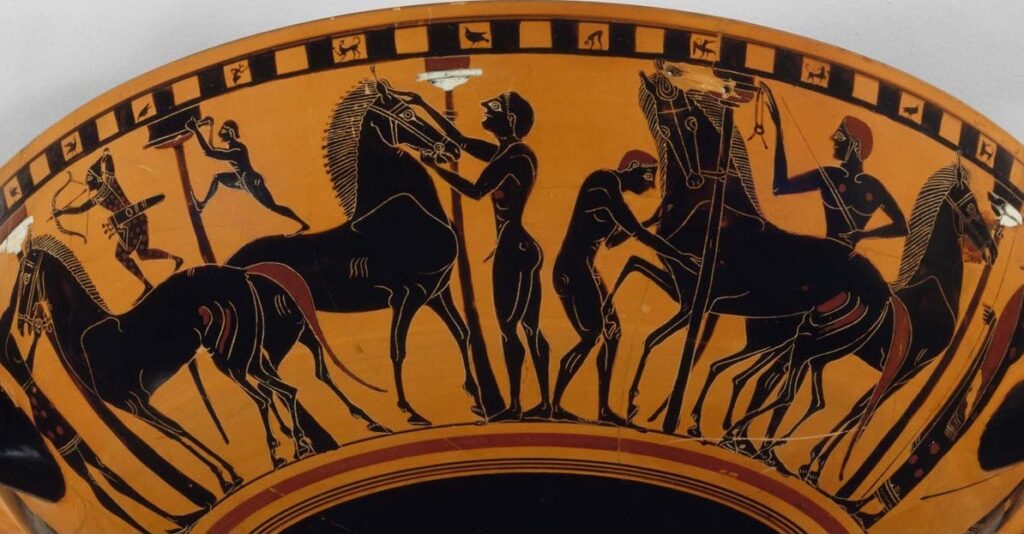
There is something rather delightful about Xenophon’s ingenuousness when he tells us quite seriously that “a horse that has no longer the marks in his teeth, neither rejoices the buyer with hope, nor is easy to be exchanged”! He speaks too with emphasis when assuring us that when carefully examining a horse with a view to purchase we ought to pay most attention to the hoofs—advice to some extent discounted by remarks he makes a few lines further on.
“To sum up all in a few words,” he says elsewhere, “whatever horse has good feet, is mild-tempered, sufficiently swift, and able to endure fatigue, and is in the highest degree obedient, will probably give least trouble to his rider and contribute most to his safety in military occupations. But horses that from sluggishness require a great deal of driving, or, from excess of mettle, much coaxing and care, afford plenty of employment to the rider, as well as much apprehension in time of danger.”
The ancients evidently had a rooted antipathy to adopting any kind of contrivance calculated to afford protection for their horses’ hoofs. Upon several occasions attempts were made to introduce metal horseshoes, but in vain. The device most resembling a horseshoe, that they were willing to consider and of which we have a trustworthy description, was a covering not unlike a sandal made of reeds, or, in rare instances, of leather. In reality it resembled a boot rather than a horseshoe, but it was used only where the ground was very rough or exceptionally hard.
In parts of Japan boots of this kind, made of straw, are worn to this day. Berenger speaks of a horseshoe said to have been in use in the time of Childeric, whose date was 481, A.D., and most likely it was one of the first horseshoes, properly so called, of which any record is extant.
If the figure of it preserved in Montfaucon’s “Antiquities” is to be relied upon for accuracy, then it somewhat resembled the shoe in use to-day.
It seems clear that Xenophon was not an advocate for docking horses’ tails, at any rate to the exaggerated extent we so often see them docked to-day, also that he was not partial to the hogged mane, for in speaking of the horse’s forelocks, “while these hairs,” he avers, “though of good length, do not prevent the horse from seeing, they brush away from his eyes whatever annoys them. Therefore we may suppose that the gods gave such hairs to the horse instead of the long ears which they have given to asses and mules to be a protection to the eyes.”
A question sometimes set when the subject of early horsemanship is under discussion is: How used the ancients to mount, seeing that they placed at best only cloths on their horses’ backs, and that they had not stirrups?
Historical records contain information upon the point, and we read that in the centuries before Christ horses were mounted apparently in three ways—by the rider’s vaulting without assistance on to the back; by his vaulting or mounting with the aid of a pole; by his making the horse crouch.
There was a fourth way, but for an obvious reason it was less often resorted to. This was by making a slave bend his back, or kneel on all fours, and by then stepping upon him—using him as a mounting-block, in short. The last-named method was common in Persia, where Sapor, when he had conquered the Emperor Valerian, forced him thus to debase himself to show his complete subjection.
I believe I am right in saying that the soldiery used sometimes to mount with the aid of a spear. Xenophon, in his seventh chapter, instructs the horseman to mount “by catching hold of the mane, about the ears,” a feat surely impossible to perform save when mounting a pony.
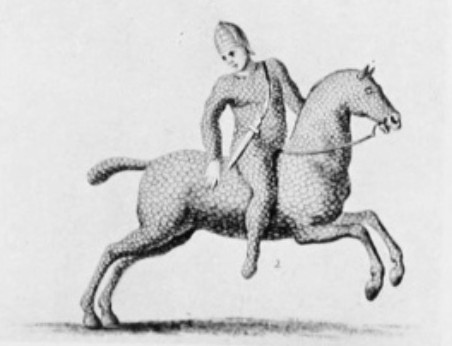
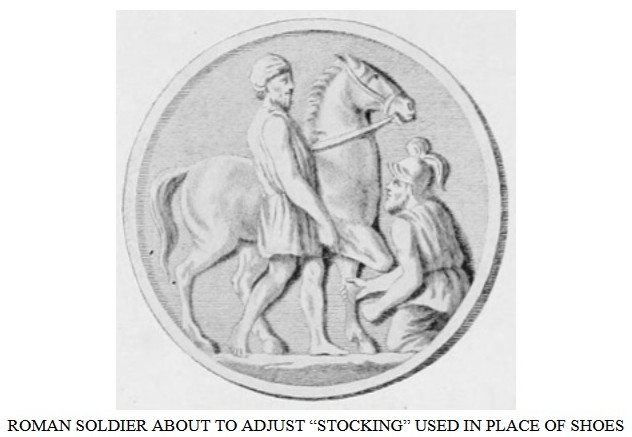
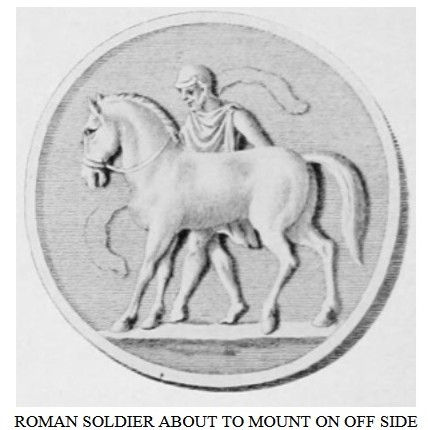
In the illustration of a Sarmatian on horseback, facing page 33, both a man and horse are shown in armour made of horse-hoof cut into little plates, which, Pausanias tells us in his Attics, were sewn together with the sinews of oxen and horses. Sometimes bone was used in place of horse-hoof, but iron never, there being no iron mines in the country, to the knowledge of the Sarmatians. The soldier shown holding up his horse’s leg, in the illustration facing page 45, presumably is about to tie on one of the “stockings” used in place of shoes; and on the same plate a soldier is about to mount on the off (right) side.
In spite of the derisive remarks often uttered concerning Xenophon’s advice to young riders, and his advice on horsemanship in general and the care of horses, there is much sound sense in plenty of the hints he gave to the Greek riders of three hundred years before Christ, while many of the rules he laid down are as applicable today as they probably were then.
His advice on the vexed question of bits and bitting, to take but a single example, is very sound, while his strong objection to allowing horses’ legs to be washed frequently is shared by plenty of horse owners at the present time.
Then, the old Athenian apparently disapproved of or disliked what we have come to call the “American” seat on a horse, for he declares that the legs of a man mounted should be almost straight, the body upright and supple.
Attempts have repeatedly been made to trace the life of Xenophon prior to the time when, in 401 B.C., he first joined the army of Cyrus, but in vain. He is, however, known to have been a close friend of Socrates from a very early age, and probably when he wrote the “Anabasis” he was a little over thirty. But when he died, about the year 355 B.C., he was quite an old man.
Historians are almost unanimous in declaring that at Marathon, in 490 B.C., the Athenians were without cavalry, though by that time many of the wealthy citizens undoubtedly owned horses, some of which they most likely used for racing. When, however, the Athenians came to realise what an amount of execution could be done, and to see the execution that was done by the Persians, with the help of cavalry, they set to work to organise in Athens, as quickly as possible, a powerful body of mounted warriors.
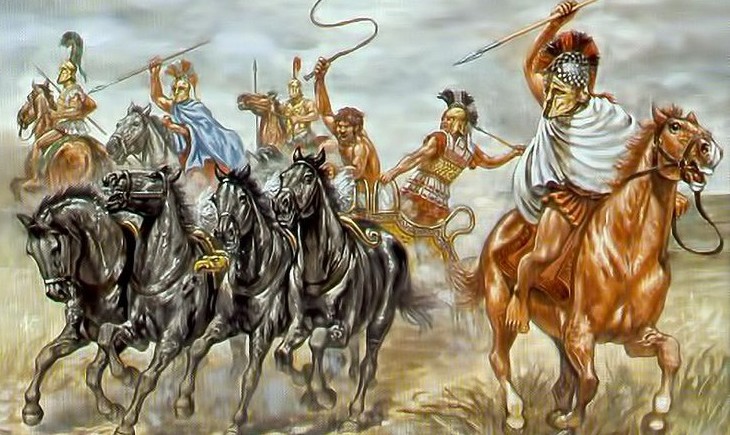
How formidable that cavalry later on proved itself to be is well known to all classical scholars, and the more surprising it therefore is that the Greek cavalry should not afterwards have risen to the level of that organised by Macedonians. Indeed, according to more than one historian, the Greek cavalry was employed chiefly to harass an enemy when marching, or to pursue a vanquished and retreating regiment, while one writer at least maintains that the Greek cavalry at best never approached within javelin range of an enemy’s line of battle during an attack.
The cost of horses at about this time varied almost as widely as it does now. Thus it was not unusual to pay three minæ, the equivalent of about fifteen guineas, for quite a common hack—an extraordinarily high price when we bear in mind the purchasing value of money in those days—while for trained war horses, or for race horses, any sum from ten minæ upward was paid frequently.
Xenophon is known to have given approximately eleven minæ for a little war horse that, so far as one can ascertain, did not afterwards fulfil expectations, so perhaps it is hardly astonishing to read that some years later the terms “horse owner” and “spendthrift” came to be deemed more or less synonymous.
A list drawn up at about this time of the principal defects to be guarded against when inspecting a horse with a view to purchase is interesting, inasmuch as the points looked upon as faults three and twenty centuries ago are with only a few exceptions deemed to be egregious defects today.
The following is the list that was drawn up, so it is alleged, by Pollux:
Hoofs with thin horn (sic); hoofs full, fat, soft and flat—or, as Xenophon termed them, “low- lying”; heavy fetlocks; shanks with varicose veins; flabby thighs; hollow shoulder-blades; projecting neck; bald mane; narrow chest; fat and heavy head; large ears; converging nostrils; sunken eyes; thin and meagre sides; sharp backbone; rough haunches; thin buttocks; stiff legs, stiff knees.
Though among the horses of the ancient Greeks the hogged mane must at one time have been seen often enough, there does not appear to be in the works of the early writers any direct allusion to the hogging of horses as a regular practice.
Probably if the custom did exist it was on the wane by the time Xenophon began to write. There is evidence to show that in ancient Greece the horses at about this period were rather smaller than those of most other countries of which we have authentic records, a characteristic still noticeable amongst the horses in several parts of modern Greece. The Greeks almost always used entire horses for all purposes. Even in war they did not employ geldings, a custom that has given rise to the belief that in the centuries before Christ all horses, with the exception of the Libyan steeds, were far more savage than the horses of today. Emphatically we have no reason to suppose that the Greeks made friends and companions of their horses as the Arab race is known to do or to have done, though the fable of Achilles’ love for his horse named Xanthus makes a pretty enough story. On the other hand, it is quite possible that Xenophon may have been fond of horses not merely because of the amusement they afforded him or the pleasure he derived from riding and hunting.
For the rest the Greeks, in common with the people of most of the warlike nations in those early days, enjoyed possessing horses mainly because they served to enhance life’s pleasure, and were of practical use in war.
Certainly it may be said of Xenophon that he did not preach the doctrine of kindness to horses without himself practising it thoroughly, also that he was ever ready to rebuke severely all who ill-treated their own horses or his.
Apparently the Greeks of about this era did not keep what we should term today pleasure horses, though they affected pleasure horses in the sense that they kept race horses. With the death of Xenophon we lose touch, to some extent, with the progress of the horse in history, but the thread is taken up again in the Roman period when Varro, writing in 37 B.C., furnishes certain details that are of interest, Virgil adding to them a little later in his “Georgics.”
After that we find instructive comment in the writings of Calpurnius and Columella in the first century A.D.; in those of Oppian and Nemesian in the third century; and in those of Apsyrtus, Pelagonius and Palladius in the fourth century.
When all is said, Xenophon’s information most likely is by far the most trustworthy of any that has been handed down to us, in the same way that his descriptions certainly are the most accurate. Only a few fragments of the book by Simo, written probably about the year 460 B.C., remain; yet even those fragments contain peculiar statements.
Thus in addition to insinuating that Thessaly was the only region famous for horses in the centuries before Christ—an assertion indirectly gainsaid by Xenophon—he didactically remarks that the colour of a horse ought not to be taken into consideration when the animal’s qualities are being summed up, a statement that the majority of the early writers openly repudiated, and that, as most of us know, is in every country deemed devoid of truth at the present day.
Though particulars are difficult to obtain, there is reason to believe that the horse named after the Thracian river, Strymon—owing to its having been bred in that vicinity—and that was immolated by Xerxes before his invasion of Greece, was, as usual, a white horse.
By exactly what route horses were introduced into Greece has not been ascertained for certain, but the fact that fossilised remains of horses have not been found in Greece as they have been in many other countries leads to the belief that the horse was not indigenous to the country.
From a very remote period, however, we find horses represented on vase paintings; and from these paintings too we are able practically to prove that the Greeks had not rowels in their primitive spurs, but that the spur consisted of a short goad attached to the heel of the boot by means of a strap passing over the instep and another that passed under the sole, almost as the modern hunting spur is strapped on. Spurs of this kind have been discovered in Olympia, also in Magna Græcia, and elsewhere.
With regard to the Greek bits and bridles of a later date, the former apparently had no leverage—certainly they had no curb chain—while the pattern of the bridle seems to have remained unaltered.
As we come nearer still to the time of Christ, we find the young men of Athens growing fonder and fonder of horse racing and taking more pains and spending much time and money in their attempts to improve the breed of horses. And though the soil of Attica was by no means adapted for purposes of horse rearing, it must in justice be said that their attempts met with reward.
Thus it happened that about this time—that is to say towards the close of the third or the beginning of the second century—the comic poet, Aristophanes, who died in 380 B.C., began to inveigh against the increasing popularity of horse racing, and against the spread of gambling consequent thereon.
In his immortal comedy of The Clouds, it will be remembered, he portrays a typical young spendthrift, Pheidippes, and an equally typical indignant father, Strepsiades, both of whom would serve well as latter-day types of men of the same stamp.
The son, when the comedy opens, has lost heavily on the turf and incurred the displeasure, not to say roused the indignation, of his father, in addition to burdening the old man heavily with his gambling debts. Presently the son is sued by Pasion, a characteristic usurer of that period, for the recovery of the entire sum of twelve minæ.
“For what with debts and duns and stable-keepers’ bills,” Strepsiades exclaims in exasperation in the opening lines, addressing his son Pheidippes, who lies asleep before him—”what with debts and duns and stablekeepers’ bills which this fine spark heaps on my back, I lie awake the whilst and what cares he but to coil up his locks, ride, drive his horses, dream of them all night….” And so on.
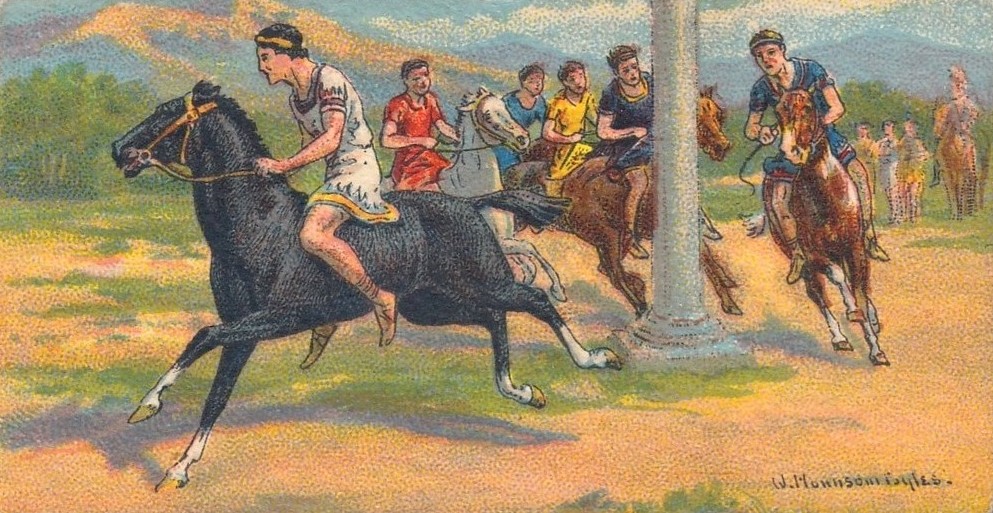
This gives us, to start with, an idea of the degree of popularity that horse racing had attained in Greece at about this time, for Pheidippes is meant to be a character drawn from life and typical of the young punters of the period.
Later we learn that the money for which the father is being sued had, in the first instance, been borrowed to pay for a “starling-coloured horse”—whatever kind of weird creature that may have been. Possibly “fleabitten” is intended, for the geographer, Strabo, speaks of “the starling-coloured horses of the Parthians” and of the people of Northern Spain, and it is known that plenty of those horses were of the colour that we should term today “fleabitten.”
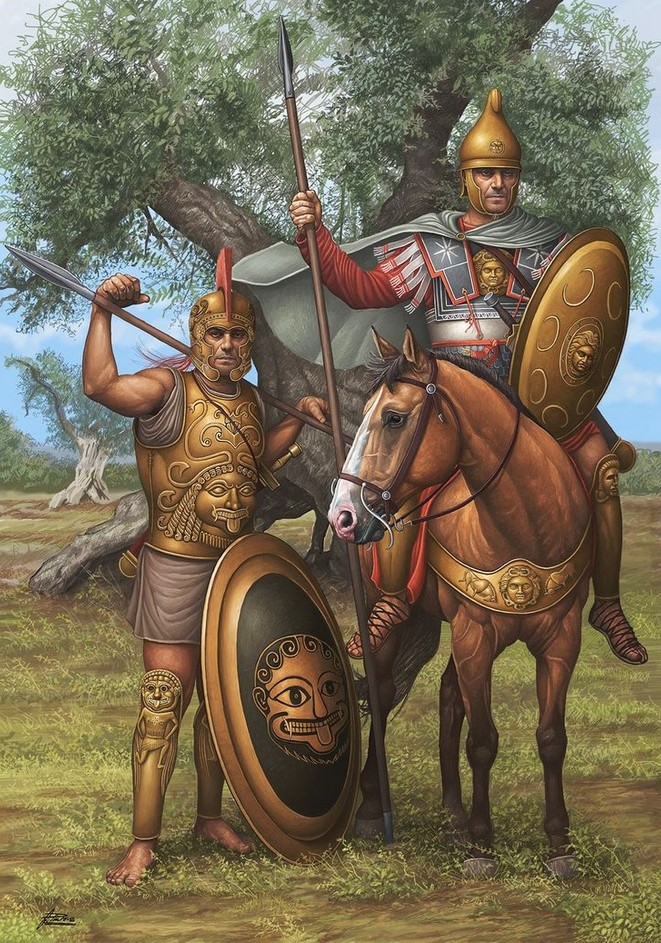
Aristotle is the next to enlighten us to some extent upon the growing fondness of the Greeks for horses, especially for race horses and war horses. He tells us too that about the average span the horses in his time—the middle of the second century B.C., 384 to 322—lived was eighteen to twenty years, though a few were said to have reached five and twenty, and even thirty, and a very few indeed to have died at fifty.
Whether the custom that then prevailed of feeding horses mostly on barley proved beneficial or the reverse in the long run we are not told. Finally we come to Alexander the Great and his renowned Bucephalus, a horse bred, as we are told, by Philoneicus of Pharsalus, a Thessalian.
Bucephalus, or rather Bucephalos, means ox head, or bull head, from which we may conclude that whatever good points Bucephalus may have had—and without doubt he had many—he certainly had not the fine head of a modern hunter or the tapering muzzle of the thoroughbred that nowadays we so much admire.
It has been stated that Bucephalus derived his name from a mark on the left shoulder in the form more or less of a bull’s head. As we know, however, that many years before Alexander’s Bucephalus was foaled there existed a type of Thessalian horse upon which the same name had been bestowed, the conjecture is probably a false one.
How great the fame of Bucephalus was may be gathered from the fact that of all the horses possessed by the ancient Greeks down to this date he alone is the animal over which they thoroughly “enthuse.” From what we are told in the writings of Aristotle, indeed, and of later historians, Bucephalus must have been quite a tall horse, well shaped, coal-black, with a good shoulder and small ears. Also he had a white star in the middle of his forehead, a mark characteristic of certain Libyan breeds of old.
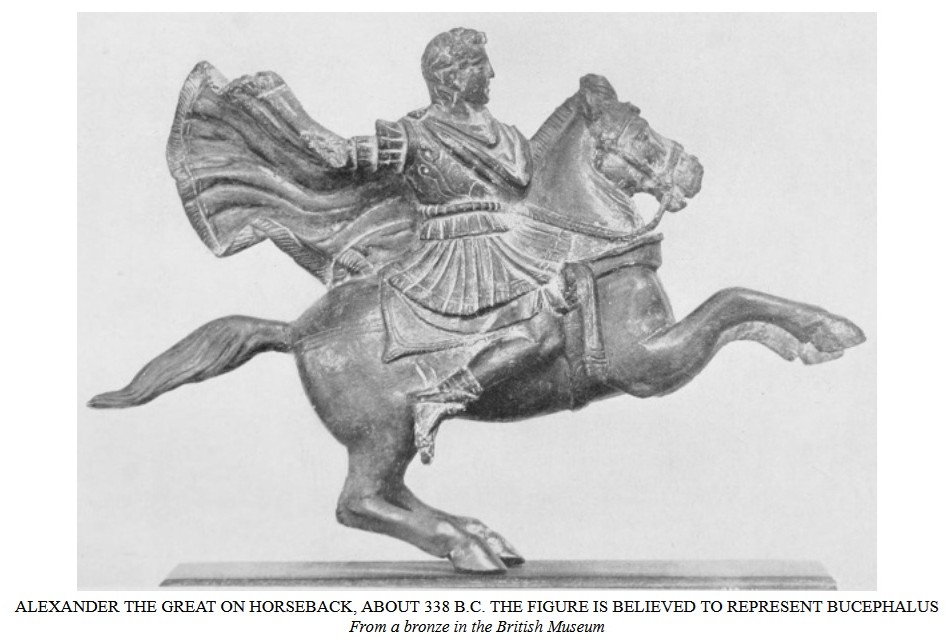
An unknown writer in the “Geoponics” avers that in the centuries just before Christ many of the best horses had eyes of different colour—what we sometimes term a wall eye, and Americans a China eye—and from his own deductions he concludes that Bucephalus probably had eyes that did not match. There does not, however, appear to be direct evidence that this was so.
Plutarch sets the price paid for Bucephalus by Alexander’s father, King Philip, at thirteen talents, while Pliny is of opinion that the price was higher still—namely, sixteen talents.
Now the sum that today would be the equivalent of thirteen talents is approximately £3500, and when we bear in mind the prices that in the second century frequently were paid even for the best horses obtainable, and recollect, in addition, that at the time King Philip bought Bucephalus the horse was probably aged—some writers aver that he must have been quite fourteen when Philip bought him — it is not possible to reconcile the statement that a fancy price in any way approaching the sum named could have been paid.
The story of the trial and subsequent purchase of Bucephalus is both pretty and picturesque. More, it would appear to be true in almost every detail. According to Plutarch, whose account probably is the most trustworthy, the horse was first brought before King Philip to be given a public trial, when, to the discomfiture of its owner, it showed itself to be apparently “a fierce and unmanageable beast that would neither allow anybody to mount him, nor obey any of Philip’s attendants, but reared and plunged against them all, so that the king in a rage bade them take him away for an utterly wild and unbroken brute.”
At this juncture it was that Alexander—at the time a boy of twelve, and Aristotle not yet his tutor—came upon the scene. We are told that he “leapt suddenly forward and in an access of indignation cried out before the king and everybody assembled that the men attempting to ride the horse were ‘clumsy clowns,’ ” adding, with the self-assurance of precocious boyhood, that “if they were not careful they would spoil the horse entirely.”
Philip at first paid no attention to his son’s outburst, deeming it to be childish spleen, but upon the lad’s refusing to be quieted he turned to him, suddenly nettled, and demanded in a sharp tone how he dare be so insolent as to criticise his elders. In no way abashed, Alexander retorted that in this instance he certainly did know much better than his elders, and that if his father would allow him he would prove it by himself mounting the horse at once and riding it round the ring. “And what will you forfeit for your rashness if you are thrown off?” the king inquired, not troubling to conceal his anger.
To which young Alexander retorted with much spirit: “The price of the horse, by Zeus!”
It is hardly likely that Alexander, rash though he undoubtedly was, would have said this if the price at which Bucephalus was valued amounted to a sum in talents equivalent to thousands of pounds, for King Philip though a just ruler was a stern father, and Alexander must have known that his father would extort the forfeit should he fail to ride the horse.
The lad’s reply, we are told, was received with shouts of laughter. This public expression of ridicule it may have been that set the boy upon his mettle, for without further parley he ran out into the arena, ordered his father’s attendants aside, and then, grasping the reins, began to pat the horse’s neck and “soothe him with soft words.”
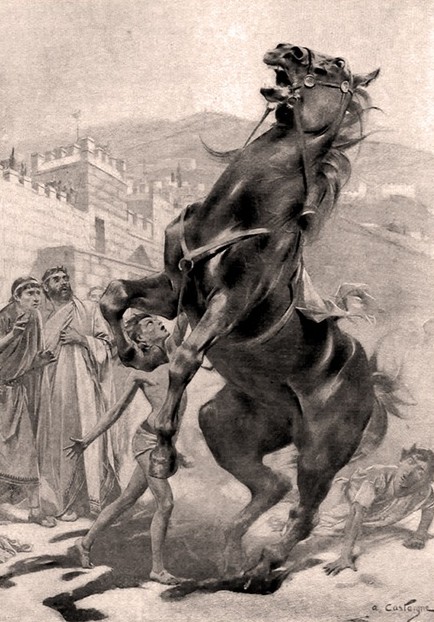
For the boy had observed what apparently nobody else had noticed—namely, that the horse grew restive at the sight of its own shadow. Without waiting, therefore, he turned the horse to face the sun, then at once “sprang up and bestrode him unharmed.” Next, gradually and very gently, and using neither whip nor spur, he made Bucephalus move round and round in a circle until the animal no longer feared its shadow and then when it had, as we are told, “given up all threatening behaviour, and was only hot for the course,” he gave the horse its head, “urging him onward by raising his voice and using his heel.”
At the sight of this fine display of horse breaking and horsemanship the spectators, now somewhat abashed at the haste they had been in to jeer, grew silent. But not for long. Presently, as Alexander came galloping back, “full of just pride and pleasure,” the assembled multitude, including the king’s attendants, “of one accord raised a great cheer, lifting up their hands from pure joy.”
Philip himself must have been of an emotional nature, for we read that “he said nothing, but wept silently from pure joy.”
Possibly the lad too suffered from “pure joy” at that moment, for upon his dismounting his father advanced with the remark that Macedonia was “not big enough for such a son,” that he “must go look for a kingdom to match him.”
Which shows that even in the centuries before Christ there was truth in the popular platitude that nothing succeeds like success!
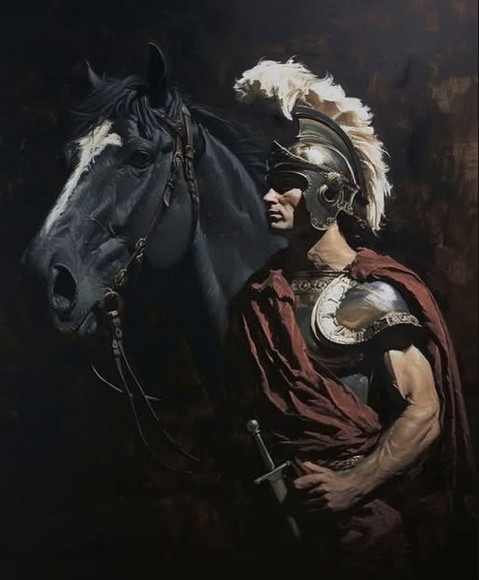
Then and there Bucephalus was bought for Alexander, and from that time until its death, from wounds received in a battle fought against the Indian king, Porus, the horse remained Alexander’s favourite charger and companion. A remarkable peculiarity about this animal was that though subsequently it came to allow the grooms to ride it bareback, yet when it had on one of the cloths that at that period did duty for a saddle it would allow only Alexander to mount it. As one writer neatly says: “When others tried to mount the horse with the cloth on they invariably had to take to their heels to save themselves from his.” It is further recorded that when Alexander wished to mount, Bucephalus would crouch of its own accord to enable its master to get on more easily.
Alexander took Bucephalus with him on his famous expeditions into the East, and on one occasion, in Hyrcania, the horse was stolen. The king “thereupon became terrible to see, so great was his rage.” At once an edict was issued that unless the horse were returned to him without delay he would “carry fire and sword throughout the country—north and south, east and west, sparing neither men nor women, nor, if need be, even the smallest children.”
A chronicler of the period, commenting upon this, drily observes that when Alexander’s determination became known, “the horse was returned in a hurry!” “Thus,” remarks Arrian, the great historian, “the horse must have been as dear to Alexander as Alexander was terrible to the barbarians.” As he here employs the word “barbarian” in its offensive signification he evidently despised the people of Hyrcania because they had sense enough to return the stolen horse instead of waiting with their kith and kin to be slain or tortured!
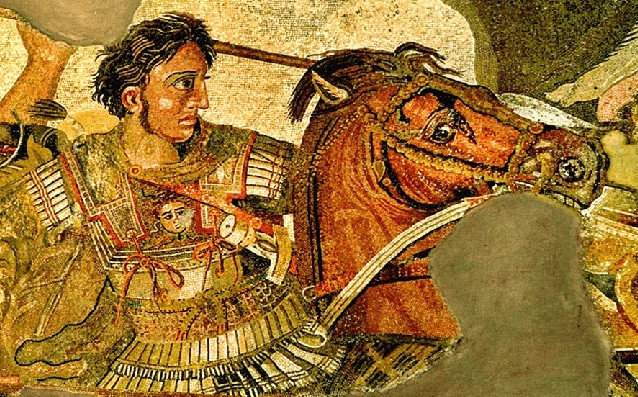
In the descriptions of almost all the great victories won by Alexander the Great, allusion is made to his favourite steed. We are told by Gellius that in the battle that practically witnessed the death of Bucephalus the king had pressed forward recklessly into the thick of the fight, and apparently right into the enemy’s lines, and had thus become “the mark for every spear” a statement which, if literally true, points to an enemy made up of singularly inept marksmen.
“More than one spear,” he goes on, “was buried in the neck and flanks of the horse, but, though at the point of death, and almost drained of blood, he succeeded with a bold dash in carrying the king from the very midst of the foe, and then fell, breathing his last tranquilly now that he knew his master was safe, and as comforted by the knowledge as if he had had the feelings of a human being.”
There is something about the concluding sentence that leads to the belief that Gellius must have been either remarkably imaginative, or else of a more romantic nature than the majority of his contemporaries have given him credit for being. The last line in particular is very precious. After reading it can one feel astonished at Alexander’s enthusiasm having carried him to the length of causing him to build a city to the memory of the noble steed, a city to which he gave the name Bucephala?
The handsome bronze discovered in Herculaneum is popularly supposed to represent the figures of Alexander and Bucephalus. The work probably of Lysippus—whom Alexander himself ordered to produce a scene representing a fight during the great battle of Granicus — it is extremely interesting.
A pleasing anecdote told of Alexander and Bucephalus, and more likely to be true than are the majority of the tales that are related of this horse and its owner, is to the effect that upon one occasion the king went to inspect a portrait of himself mounted on his favourite charger, that the distinguished painter, Apelles, had just completed.
Nettled at Alexander’s scant praise of his work—for we are told the picture was so lifelike that even Bucephalus neighed when first he saw it—Apelles turned to the king with the rebuke: “I fear me, your Majesty, that your horse is a better judge of painting than his noble master.” What retort the king made is not recorded, but the story recalls one of a similar nature related of the famous artist, Pauson, who when ordered to produce a picture of a horse rolling on its back, sent to his patron a picture of a horse galloping madly through a cloud of dust.
In a great rage the patron sent for Pauson, and, upon his arrival, “began to storm and rave,” at the same time demanding to know what had made him commit a blunder so egregious. Without replying, Pauson walked up to the picture and turned it upside down, when, to the vast amusement of the hitherto irate patron, there appeared a perfect picture of a horse rolling on its back on a dusty plain.
Of the famous artist, Micon, it is related that he once incurred the criticism of the rider, Simon, who, upon looking at one of his pictures, remarked drily that never in his life before had he seen a horse that had eyelashes on its lower lids!
It seems certain that in the centuries before Christ the steeds bred in Thessaly were among the most highly prized, though the horses of several other breeds—such, for instance, as the Argive, the Arcadian, the Epidaurian and the Arcananian—possessed great courage and exceptional power of endurance.
In the very early times Thessalian horses were used largely for charioteering. Allusion is made repeatedly in the classics to these Thessalian animals, stress being laid upon their symmetry, or what today we should term their make and shape. The mythical mares of King Diomed of Thrace, the tyrant whose grim humour, we are told, led him to feed his horses on the strangers who visited his kingdom, were alleged to be of the breed of Thessaly, a statement made indirectly in the description of Hercules’ conquest of the tyrant and his subsequent “casting of the tyrant’s quivering carcass to his own horses to be devoured.”
Spenser alludes to this incident in the fifth book of his “Faerie Queene,” in the following lines:—
“Like to the Thracian tyrant who, they say,
Unto his horses gave his guests for meat,
Till he himself was made their greedy prey,
And torn to pieces by Alcides great.”
Other mythical horses of the Thessalian breed were those of Achilles, of Rhesus, and of Orestes in Sophocles’ stirring description of the race in Electra.
It seems safe to say that until about the fourth century B.C. the Romans also did not use saddles, at least saddles with trees. That somewhere about this period, however, they began to adopt what we should call today saddlecloths, and that these were kept in place by a strap or bandage in the nature of a girth that passed beneath the belly, appears to be certain.
For some unknown reason this girth is more often than not omitted on the works of art that represent horses of that period. Some of the animals of the Parthenon frieze lead us to believe that on occasions horses were still made to crouch when about to be mounted, though it is not probable they crouched voluntarily, as Bucephalus did. From impressions on the Parthenon frieze we may also conclude that the mounting block was not unknown in the centuries before Christ.
A good idea of the exact stamp of horse harnessed to the war chariots of those centuries may be obtained by inspecting the bronze horse of the quadriga from the Mausoleum at Halicarnassus, the date of the Mausoleum being 331-341 B.C.—the building took ten years to erect. This bronze is to be seen in the British Museum.
Hannibal’s must have been the army the best provided with cavalry down to the year 218 B.C., for in that year Hannibal advanced into Italy with no less than 90,000 foot and some 12,000 horse, many of the latter being native horses mounted by Numidians who persisted still in scorning to use either saddle or bridle, though the cavalry division, which consisted of Spaniards, employed bridles of an elaborate pattern.
How wholly superior Hannibal’s cavalry proved to be to the Gallic horsemen placed by Scipio in the front line of his javelin throwers is well known to students of history. Indeed it was said that Hannibal’s horsemen were superior even to the Italian and the Roman cavalry, which was high praise.
Probably from about the year 200 B.C., possibly from an even earlier period, the Romans used spurs, apparently the common prick spurs which remained in vogue until towards the middle of the thirteenth century A.D. Some half-a-century later, or about the year 150 B.C., there were issued in succession a series of Gaulish silver coins, the majority of which bore upon one side the impression of a horseman, though comparatively few showed the chariot at one time so generally represented on coins.
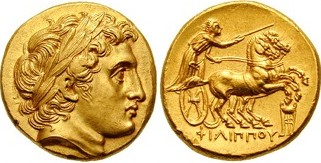
This leads naturally to the inference that the popularity of the chariot was already waning. Chariots, however, continued to appear upon the gold coins made in imitation of the gold stater of Philip II of Macedon, coins that bore on the face Apollo’s head, on the reverse a two-horse chariot.
Exceptionally fine horses, probably with Liberian blood in them, must have been owned by the Iberians and Celtiberians at about the period the Stoic philosopher Posidonius was travelling in Western Europe, and when he incidentally visited Spain—about the year 90 B.C. Posidonius himself remarks that the cavalry of the Iberians was trained to travel over mountains, adding that these horses too would crouch when told to, in order that their riders might mount or dismount with greater ease.
A method to which this cavalry sometimes had recourse consisted in their mounting two men on one animal. Then, in the heat of action, one of the men would fight on foot, the other remaining by to defend him if hard pressed. The same philosopher tells us that the horses of the Parthians and Celtiberians “indeed were superior to all other breeds in fleetness and endurance.”
(1868–1949)