
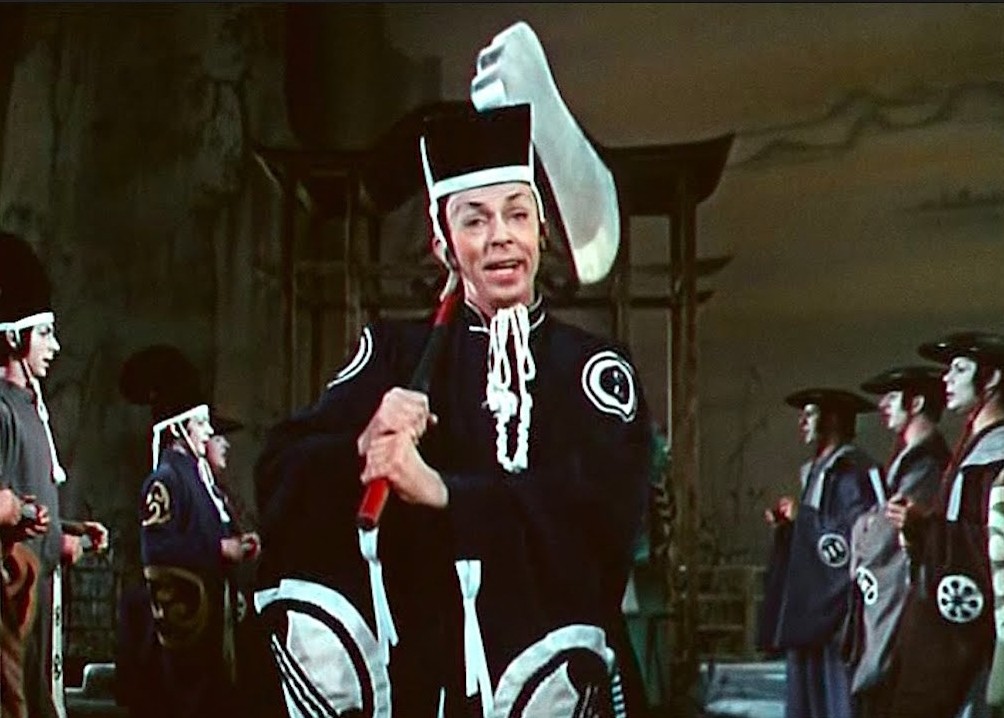
Editor’s note: The following is extracted from Sullivan’s Comic Operas, by Thomas F. Dunhill (published 1928).
It would be difficult for anyone but the dullest literary bookworm or the stodgiest musical pedant to write without enthusiasm of the next opera of the series, The Mikado, or The Town of Titipu, which was first presented to a public which had been waiting for it with unprecedented eagerness on March 14, 1885. The date may be regarded as a red-letter one in the annals of English dramatic and musical art. It was obvious from the very first that this was a work of historical importance and that in it the two partners revealed a maturity of execution which they had not previously so completely demonstrated.
Iolanthe might have been more fanciful and its humour based on a more poetic foundation; Princess Ida might make a stronger appeal to educated musicians by reason of its greater intimacy of style and fastidiousness; but The Mikado was incomparably more brilliant than either, and showed a continuous vivacity of movement which all the world could recognize and enjoy.
It was indeed, not long before a very large portion of the world was engaged in that recognition and enjoyment. Not only was the work hailed with delight in the United States, but the libretto was translated into other languages, and in Germany, particularly, The Mikado won as ready an acceptance as in the country of its birth. A musical conquest in Germany always gives a special cachet to an English composer. In Sullivan’s case this was no mere complimentary success, but an immediate and permanent victory. The Germans freely admitted that The Mikado surpassed all their own classic examples of operetta or ‘Singspiel.’ They did not hesitate to accept it as a great comic-opera, and they produced it in all their leading musical centres, sometimes on a scale unknown in this country except in grand opera. It was directed by their most famous conductors, including Arthur Nikisch, and regarded as a work of genius by their principal professional musicians. These happenings are the more significant when we remember that Sullivan’s colleagues at home were deploring what they regarded as the shocking levity of his methods, and shaking their heads over the circumstance that one of their number should descend to the debasing occupation of writing music which others less learned than themselves could listen to with pleasure. That German musicians of forty years ago should have shown a prompter discernment than our own prominent professors is, no doubt, a saddening reflection for us to-day, but we may find consolation in the fact that there was, at least, a large proportion of our own populace, outside this narrow circle, which was ready to welcome a native achievement.
If a man’s masterpiece is the work which appeals to the largest number of people of all nationalities and shades of thought, then it must be said that The Mikado was Sullivan’s chef d’œuvre.
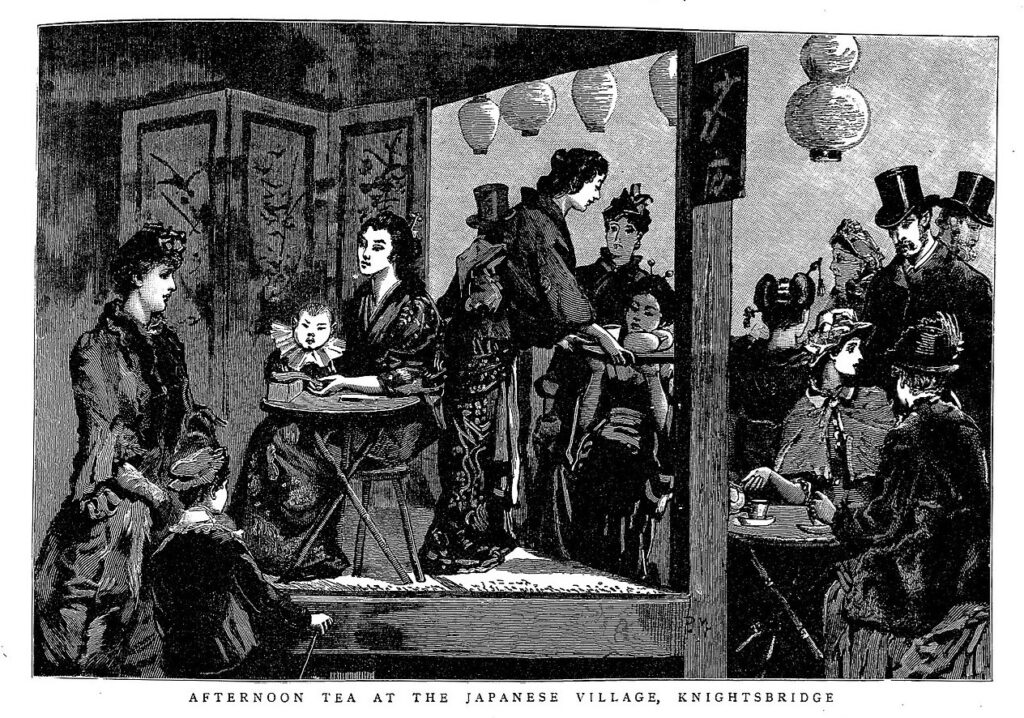
As with most of the other operas a topical event was the starting-point from which the author and composer set forth upon their humorous excursion. Even a few years earlier, in Patience, we can note that an interest in Japanese art was affected amongst the aesthetics of that period. By the time that The Mikado came into being this interest had extended to the general public, chiefly through the opening of a show Japanese village, in Knightsbridge, which was peopled by real native artificers, jugglers, tea-girls, etc., and excited very great curiosity amongst London sight-seers, who were fascinated by the costumes and quaint deportment of the little people from the Eastern seas.
Enormous pains were taken to make the stage-setting of the new opera as like the real thing as possible, and Gilbert, in rehearsing the piece, obtained the assistance of Japanese artists and performers, who coached the company in walking, dancing and manipulating their fans. Except in the staging, however, there was very little in the way of local colour to be found in The Mikado. The author’s gibes were directed more towards the English than the Japanese, and the composer, though he toyed prettily enough with the ‘pentatonic’ scale[1] in a few places, and actually imported one real Japanese tune, did not bother himself to go very deeply into the matter. The opera is, in all essentials, a typically English affair, and even the names chosen for the characters are mostly made up, amusingly, of English words which have a Japanese sound. We have Ko-Ko, the Lord High Executioner, a ridiculous upstart who is betrothed to his ward, Yum-Yum: we have the immortal Pooh-Bah (born sneering) who is Lord High Everything-Else, and the arch-type of all multiple place-holders. Then there is Pish-Tush, a noble Lord, and Nanki-Poo, the Crown Prince of Japan, who appears disguised as a second-trombone player, endeavouring to escape from the clutches of Katisha, an elderly lady of his father’s court who is in love with him. These, together with Yum-Yum’s two sisters, Pitti-Sing and Peep-Bo, and the great Mikado himself (a terrifying despot with a craze for devising the most horrible punishments for his subjects) complete a compact little cast of distinctly comic types.
The story woven around them need not concern us greatly. It does not aim at being particularly dramatic, except in one episode, where the ugly Katisha is made to exhibit some malignity of a theatrical kind. It certainly makes no pretensions to coherence or consistency, but it deals with the idiosyncrasies of the various personages employed in it in a most delightful way, and in none of the operas are these characteristics seized upon more quaintly for illustration by the composer. There is a kind of glitter in the music of The Mikado which gives it a specially bright colouring of its own. We feel this at once in the overture, although this is by no means one of the best examples of Sullivan’s constructive skill. After a mildly barbaric beginning (based upon the Mikado’s entrance) and a charming orchestral version of Yum-Yum’s song in Act II, we launch into the impudent humours of the tune which is sung by Ko-Ko and Katisha at the end of the piece. Here the pert little fragment

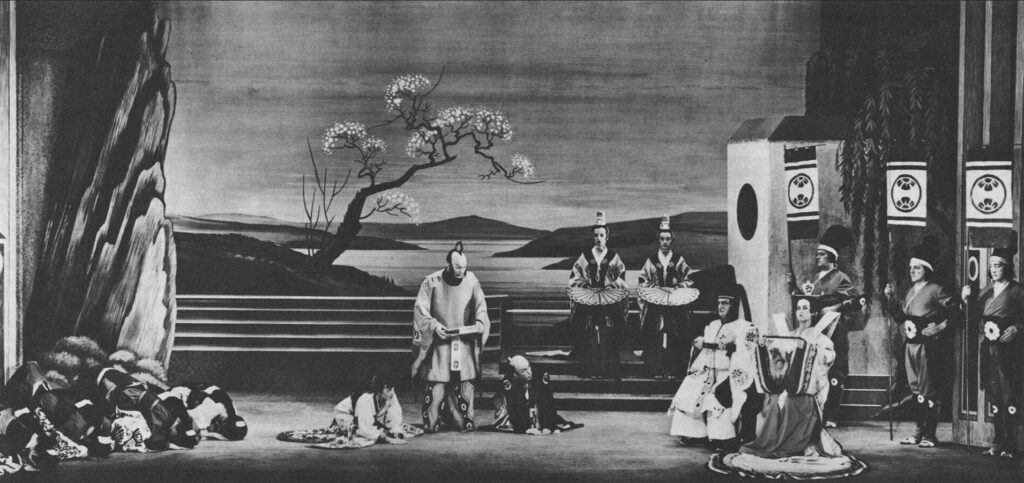
is tossed about and teased by the composer in almost too insistent a manner; it is not developed, but simply repeated in various keys till it begins to outstay its welcome. Nevertheless we feel the peculiar fascination and sparkle of the composer’s idiom in this irresponsible playfulness, and there is some compensation in the better constructed brilliance of the ending, in which the barbaric theme of the opening and the big tune from the end of Act I are both effectively brought into play. When the curtain rises, during a little prelude remarkable for swirling passages (in widely-spread unisons) on the wood-wind, we see a group of Japanese nobles in attitudes suggested by the pictures which are familiar to us
“On many a vase and jar—
On many a screen and fan.”
The music is stiff and angular to match the movements of the singers, and one may observe that the opening vocal phrases are confined to the notes of the ‘pentatonic’ scale. The accompaniment is precise but busy. A very notable effect is gained in the second verse by switching over suddenly from the key of G to the key of C, and the final section, with its detached chords for the voices and sharp incisive orchestration, is extraordinarily effective. A return to the swirling wind passages is suddenly arrested by the appearance of Nanki-Poo, who comes in haste to inquire, in recitative, “where a gentle maid dwelleth named Yum-Yum.” Pish-Tush asks him solemnly who he is, and he replies in an extended solo “A wand’ring minstrel I,” which is one of the chief early successes of the opera. Beginning in serenade style, Nanki-Poo describes his “ballads songs and snatches,” first giving a sample of a sentimental love-song, with sighing roulades. Then, to the sound of trumpets, he sings a very English patriotic ditty, following it up with an even more typically English “song of the sea,” with a “yeo-ho, heave-ho” chorus, which is irresistibly comic when sung to traditional nautical actions by the stiff Japanese figures. Just as his hearers are getting thoroughly roused up the music suddenly relapses into the serenade mood, and ends as it began,
“A wand’ring minstrel I,
A thing of shreds and patches,
Of ballads songs and snatches
And dreamy lullaby,”
and the noble gentlemen, as if ashamed of their unwonted exertions, resume their stiff pensive attitudes. The whole of this scene is set by Sullivan with wonderful facility and skill, and not a single humorous point which music could intensify is missed. The sailor song is particularly breezy, the chorus singing their parts in the jovial refrain to a surging accompaniment which is almost realistic.
Pish-Tush’s musical narrative (an explanation of the strange circumstances in which Ko-Ko has been promoted to his high position) follows, and this, an extremely good song in itself, is specially noteworthy for the brilliance of the orchestral setting.
Picturesque orchestration also greatly enlivens the next song, sung by Pooh-Bah with the assistance of Nanki-Poo and Pish-Tush. Sullivan’s quiet rhythmical use of wind and side-drum here is well worthy of study. He has to describe how, at Ko-Ko’s wedding, “the brass will crash and the trumpets bray,” which he does by gentle suggestion, without disturbing the pulsation of the song or drowning the voice-part.
Brass and drums, however, are unrestrained for the entry of the Lord High Executioner, who arrives to the sound of pompous fanfares and another thoroughly western tune, more suggestive, perhaps, of the “Fine Old English Gentleman” than the miserable whipper-snapper it is intended to extol. And herein, no doubt, lies some of its satirical sting.
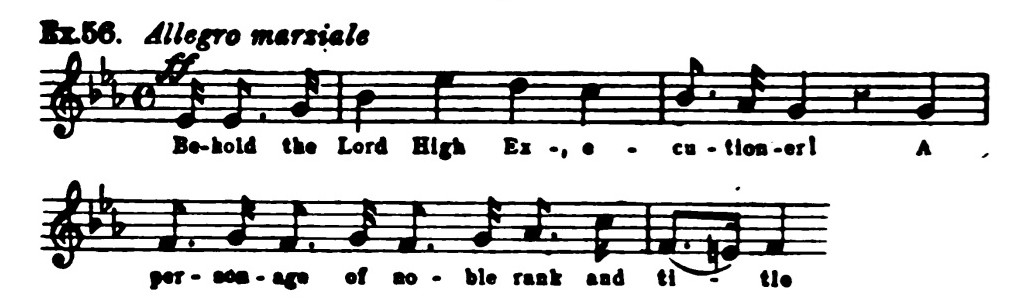
Ko-Ko’s first little solo, “Taken from the county jail,” reveals another touch of mastery in the orchestration of a very simple accompaniment, and the number ends with a resumption of the martial strains which greeted his appearance. The choral writing throughout this, though elementary, is remarkably telling, not only in the mocking homage of the forte passages, but also in the soft repetitions of Ko-Ko’s words which serve to mark the rhythm of the solo section. Sullivan was never more thoroughly at home than when he was exploiting the varieties in colour of which a male-voice chorus is capable.
We may pass over Ko-Ko’s famous solo about the people who “never would be missed.” In a musical sense there is little to be made of a mere comic song of this kind, and Sullivan shows his wisdom by allowing the words to be unfettered by any definitely illustrative setting. He concentrates upon the opportunity for a complete change of mood which is offered him at the entrance of the Japanese maidens. Up to this point male characters have had it all their own way: now we hear the brighter treble tones of the bashful schoolgirls, all “eighteen and under,” who, shy and wondering, enter to music which is, in itself, both wondering and shy. Here is the rhythm:
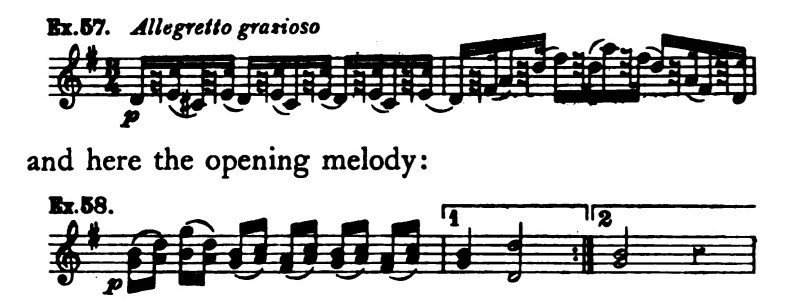
Gilbert never wrote more pretty verses:
“Comes a train of little ladies
From scholastic trammels free,
Each a little bit afraid is,
Wond’ring what the world can be!
“Is it but a world of trouble—
Sadness set to song?
Is its beauty but a bubble,
Bound to break ere long?”
Assuredly Sullivan never supplied more delicately pretty music. Let us observe how the rhythm of Ex. 57 is continued in every bar of the music, and how charmingly the smooth answering phrases of sopranos and altos, at the words
“Are its palaces and pleasures
Fantasies that fade?”
contrast with the timid fluttering of the opening two-part tune.
One little masterpiece of delicacy is no sooner over than it is followed by another, less sedate but far more playful, as Yum-Yum, Pitti-Sing and Peep-Bo (“three little maids from school”) shimmer gracefully down the stage together.

It is possible for music to be wreathed in smiles, and Sullivan was a master of it in that mood, but if ever music contrived positively to titter it was here. Once or twice it is even heard to giggle:
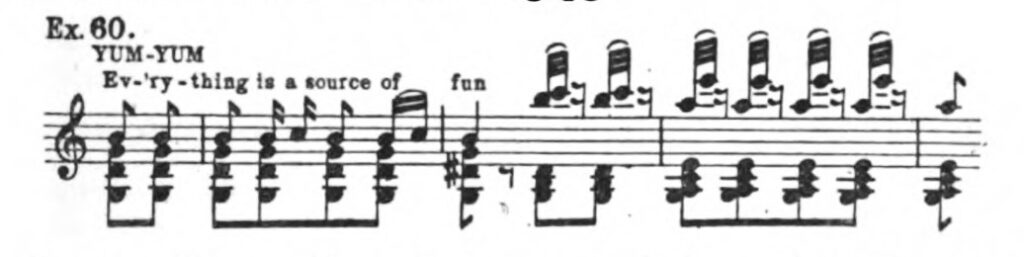
And could anything show more witchery than the use of the silent bar, just before the end of two of the verses? Was Sullivan afraid that it could never be silent enough when, on the occasion of rehearsing one of the revivals, he broke this silence by pencilling a little curling phrase into the bassoon player’s part? This stroke is amongst the most delicious of after-thoughts, but is not in the original score. One would gladly hear the passage both ways, on different occasions.
The cheery Quintet, memorable for the episode in which Pooh-Bah sings his stolid tra-la-las against the smooth swinging melody of the upper voices, is also a clever number, but not quite so charmingly graceful as the last two. Nor is the ensuing soprano and tenor duet amongst the best items of a score which is in the main so good that it is impossible to preserve the high quality at first established quite without a break.
On the other hand in the male-voice trio, for Ko-Ko, Pish-Tush and Pooh-Bah, we have the composer in his most richly inventive mood. Each of the participants sings his own bit of melody, beginning with Pooh-Bah (who certainly has the best tune)

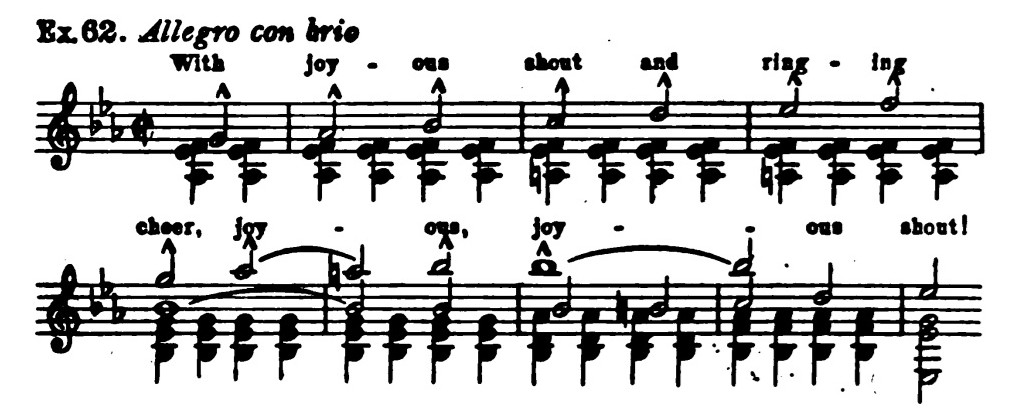
and afterwards the three melodies are blended together, and rounded off with a snappy piece of tongue-twisting alliteration about “a cheap and chippy chopper on a big black block.” The rhythmic precision of this amusing coda, enforced as it is by graphic orchestration, makes it one of the most telling strokes of musical wit which the opera affords. The Finale to Act I, though not always convincing dramatically, is, from the musical standpoint, a considerable achievement. The steady march of the populace who assemble to hear from Ko-Ko the name of his victim, has the right note of expectancy. When it is disclosed that Yum-Yum is to be surrendered to Nanki-Poo on condition that he will allow himself to be executed at the end of a month, a big joyous ensemble is built up, interrupted by Pooh-Bah’s unctuous recitative (with its florid conclusion, “Long life to you—till then,”) but culminating in a grandiose repetition of a fine passage in which the sopranos climb up the scale to a top B flat:
Katisha’s sudden appearance presents a vivid stage picture, and the music here is suitably theatrical, if in a rather conventional way. Her song, however, has a striking initial phrase, and is an extremely well-devised example of sustained agitation:

Pitti-Sing’s interruption, with its cheeky, taunting refrain:
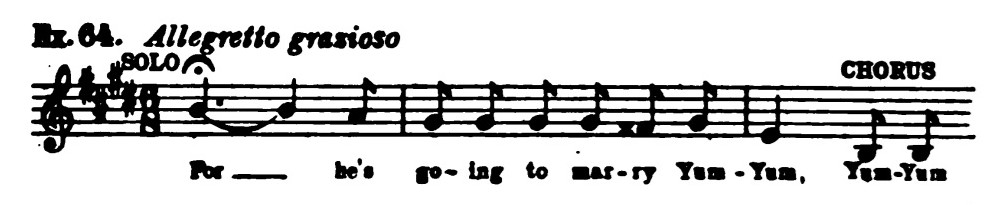
brings us back, with a bump, from the melodramatic to the comic, and the change is welcome. So far so good. But unfortunately we have not quite finished with Katisha. She has to attempt the disclosure of Nanki-Poo’s identity, and this is never a very comprehensible scene. In one revival of the opera Nanki-Poo produced his trombone, and succeeded in drowning Katisha’s voice by blowing fierce blasts which were not in the score! The experiment has never been repeated, but it undoubtedly helped a very unconvincing situation, for one is always at a loss to know why the crowd should be so anxious not to hear the disclosure. It is not the way with crowds.
Nevertheless it cannot be denied that Sullivan, hampered though he was with such material, served the librettist with extraordinary efficiency. Katisha’s disjointed phrases are broken into by the most uncanny cries, to Japanese (?) words,
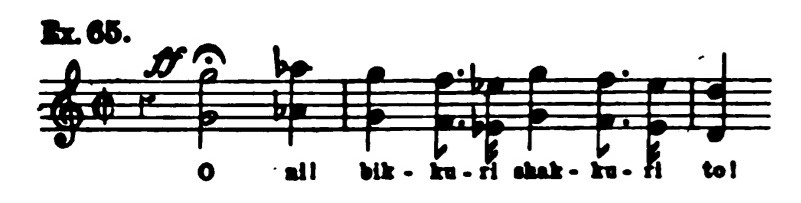
until she finally gives up the struggle, and the act ends with an exultant ensemble of remarkable strength, crowned with a splendid broad tune which sweeps all before it:
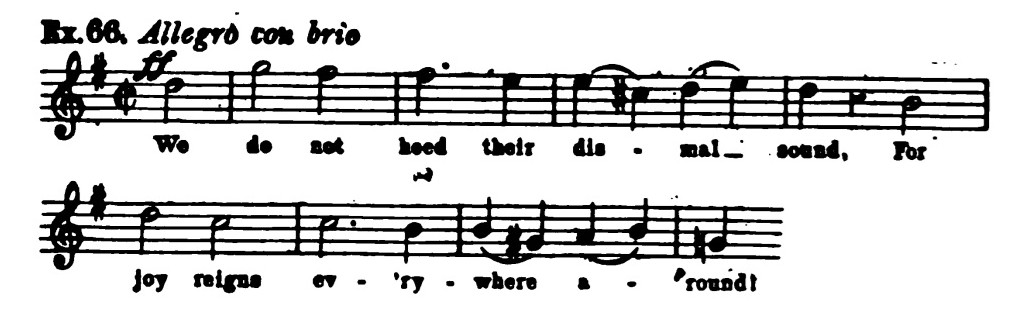
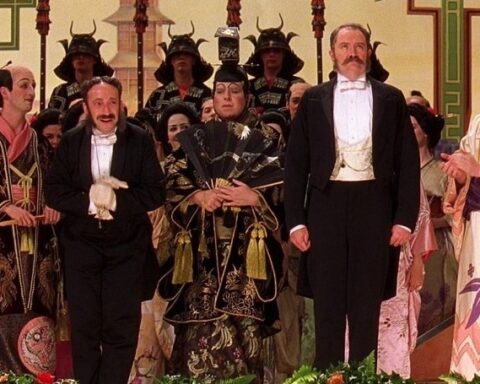
The picture at the fall of the curtain—the baffled Katisha crying for vengeance from the steps at the back of the stage—is an imposing one, and the music is thoroughly in keeping. Yet one feels that both librettist and composer have expended too much powder and shot upon a scene which is wholly incomprehensible—that the heavy-handed grand-opera flourishings imported here do not quite ring true, and tend to destroy the unity and consistency of what is, after all, a light musical satire and not a drama of conflict.
There is nothing in the second act against which such a criticism as this could be levelled. It is all pure joy. Moreover there is no diminution of technical resource, as we find in the second half of one or two of the other operas. The opening chorus of girls, as Yum-Yum is being painted and decorated for her wedding, is a lyrical effusion of the most delicate description, orchestrated in a masterly fashion. The piano score gives not even a hint of what really happens in the accompaniment. Still more fragrant is Yum-Yum’s little solo ; Gilbert has provided delightful lyrics in a mood of the most innocent egoism, and Sullivan’s music is a little miracle of apt word-setting, with a shapely melody which is greatly enhanced, once more, by graceful orchestral commentaries.
In connection with this song it is interesting to find that Dr. Percy Buck (King Edward Professor of Music at London University) in his book The Scope of Music[2] has some pertinent allusions to the unique skill which the composer has exhibited. “The writing of a learned eight-part fugue,” he tells us, “is within the power of any musician who cares to waste his time in learning how to do it; but if he tries to reset the words “The sun whose rays are all ablaze,’ and then compares his music with Sullivan’s, he will have no doubts as to which is the more serious task.” An English University professor who is ready to acknowledge the artistry displayed in The Mikado, as handsomely as this, is such a rarity that the circumstance seems worthy of special notice here.
In the so-called Madrigal for four voices (partly accompanied, which no real madrigal ever is) we have, perhaps, the most wholly pleasant specimen of vocal ensemble writing which can be found in any of Sullivan’s works. It may be remembered that even his strongest opponent characterized it as “in its trifling way” the work of a “delicate-handed artist.” One can readily accept both descriptions. It is a trifle, certainly, and does not attempt to be anything else, but it is wrought with the same degree of finish that we find in a Ballet by Morley, whose style it faintly recalls, especially in the cheery imitative ‘fa-la-las’ at the end of each verse. The little patches of orchestration are devised to help the singers. One can recall many occasions, however, when they have only served to show up bad intonation!
After a merry little Trio (“Here’s a how-de-do”), with a humorous parlando finish, we come to the one real Japanese tune, imported into the score to give local colour and add ‘artistic verisimilitude’ to the entrance of the Mikado. How or where Sullivan picked it up we do not know. It has the merit of sounding just like what a European would imagine a Japanese tune to be. Actually it turned out to be an unfortunate choice, for Sullivan was afterwards rather severely rebuked by a shocked native, who disapproved of the use, for such an exalted purpose, of what he declared was “the foulest song ever sung in the lowest tea-house of Japan.” However, it was the music alone which was ‘translated,’ and the tune, as it stands in the opera, shows no traces of its low origin, but strikes one as being rather complacently pompous.
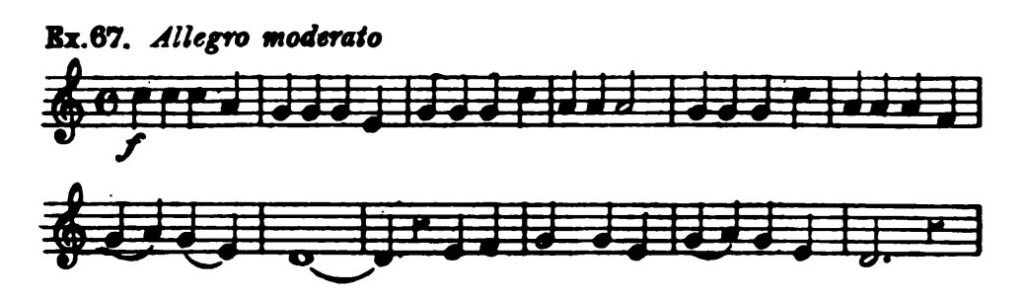
The Mikado’s first utterances (with Katisha’s interruptions) are set with a certain stiff simplicity—he is a particularly starchy and unbending monarch—but the famous solo in which he devises a number of original punishments intended ‘to fit the crime’ is a markedly humorous effusion, in which Sullivan indulges in an exceptional variety of realistic touches in the orchestra. One point about the chorus of this song is very striking. It is in A major and after modulating to E it suddenly plunges, by means of one chord, into D major. A modulation to the sub-dominant key in a tune of this kind is as unusual as a modulation to the dominant is common, for the reason that in the first case it is seldom easy to return to the original tonality in a convincing way. This seemed to give Sullivan no trouble at all, for though the new key is firmly established we feel that the tune ends quite naturally and satisfactorily on a definite tonic A. Composers with a turn for experiment might try their hand at doing the same thing. As in the case of Dr. Buck’s suggested test, they will probably find it far more difficult to negotiate than they imagine.
The Trio, in which Pitti-Sing, Ko-Ko and Pooh-Bah attempt to appease the Mikado with details of the supposed execution—related from three separate points of view—is a treasure of humour. The lyrics are first-class, and they are set to one of those marvellously supple tunes which seem adequate to express every turn of Gilbert’s changing fancy equally well. It is curious how often Sullivan chose the alternating keys of E minor and E major for narrative songs. It would certainly be impossible to imagine this one in any other tonality.
If there is one point that gives more pleasure than anything else in the song it is the extreme self-satisfaction expressed in the major section, when Pitti-Sing relates her share in the proceedings:
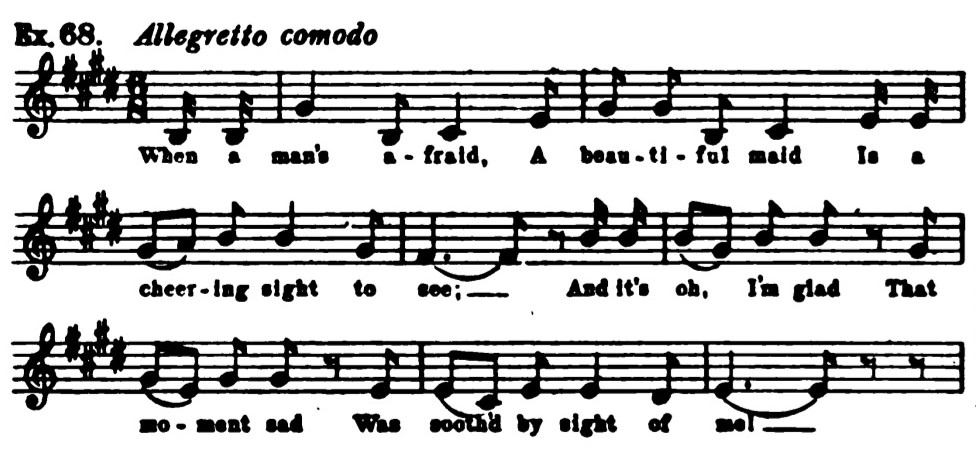
The mixture of shameless egotism and bland innocence here is surely inimitably expressed! The gay little Quintet “A is happy—B is not” (curiously described in the score as a ‘Glee’), and the familiar lilting humours of “The Flowers that bloom in the spring,” are in quite a different vein, but equally perfect. They are both infectious instances of the laughter which enlivens Sullivan’s music to this opera.
Perhaps, after these merry moments, the listener is hardly in tune for the sudden seriousness of Katisha’s song, “Hearts do not break.” It is not quite on a level with the best of its kind, but the intrusion is brief, and the scene of Ko-Ko’s outrageous wooing, which ensues, provides us with a final touch of musical humour which, despite the absurdity of Gilbert’s text, sounds an unexpectedly plaintive note. Unfortunately this note is seldom pitched aright. Ko-Ko’s “Tit-willow” is, probably, of all Sullivan’s songs the least understood and the most frequently abused. It needs to be sung with an air of absolute sincerity. The modern plan of clowning it, indulging in falsetto ‘tit-willows,’ etc., is ruinous. As a deliberately funny song it is a failure, but given simply, with no affectations or exaggerations of voice or manner, it is a supreme success. It can make the whole of this wildly impossible scene convincing in an unexpected way. One may believe that it was in this quietly pathetic mood that the absurd little tragedy of the tom-tit was sung by George Grossmith (the original Ko-Ko) and probably no other comedian seen in the part has had command of the same power of appeal at this difficult moment. Unless Ko-Ko, shameless upstart though he be, is shown to be possessed of an aptitude for simulating refinement and sensitive feeling in order to conquer Katisha, the ending of The Mikado inevitably falls rather flat, however much one may have enjoyed the lively humours of the rest of it.
The duet which follows (in which, by the way, it is almost incredibly difficult to sing the words clearly in the proper rhythm and at the proper pace) marks a return to broader methods of merry-making. It has a jolly rollicking tune, a portion of which is quoted early in this chapter in discussing the overture (see Ex. 55). After this the events of the opera quickly press on to a finish, and the brief Finale, having nothing new to tell us, brings down the curtain on some welcome recollections from the first act.
The Mikado, as might be surmised, had a triumphant career at the Savoy. Six hundred and seventy-two performances were registered before it was withdrawn—an unbroken spell of prosperity which was not equalled in the case of any of Sullivan’s other operas. It has been revived constantly and never failed in its appeal. Whether the widespread success of the work has had a favourable influence on the progress of English music, or any influence at all, is a matter upon which expert opinions seem to differ.
Sir Henry Hadow, in one of his excellent historical surveys of music, has declared that although Sullivan has “enriched the gaiety of nations,” yet “in the general advance a writer of comic-opera, however successful, can be little more than a skirmisher.” Well, The Mikado, at all events, has been skirmishing to some purpose all over the globe for over forty years, and is likely to be still skirmishing when most of the works which have contributed to “the general advance” have been interred and forgotten. Perhaps it is, after all, not a bad thing to ‘skirmish’ so efficiently as this.
Of course there is always, in artistic as well as in physical life, a possibility of the survival of the unfit, and many serious-minded people may regret the continued success of a work which sets out to depict life in such a wholly frivolous manner. For good or ill, however, The Mikado holds a place throughout the wider musical world amongst the unassailable classics, and is regarded abroad, without question, as England’s supreme achievement in the sphere of opera.
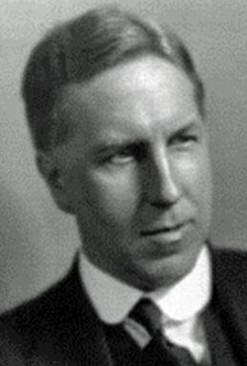
1877-1946
__________________________________
[1] A scale of six notes, upon which the music of Japan and other Eastern countries is mainly based. The black notes of the piano keyboard, from F sharp to F sharp, give an adequate idea of this scale.
[2] The Scope of Music, Percy C. Buck (Oxford University Press).



Excellent review by the late Mr. Dunhill. My only real quibble over his review was this: “The picture at the fall of the curtain—the baffled Katisha crying for vengeance from the steps at the back of the stage—is an imposing one, and the music is thoroughly in keeping. Yet one feels that both librettist and composer have expended too much powder and shot upon a scene which is wholly incomprehensible—that the heavy-handed grand-opera flourishings imported here do not quite ring true, and tend to destroy the unity and consistency of what is, after all, a light musical satire and not a drama of conflict.”
He missed the point of what the operetta was accomplishing here: even the heavier tones of a more serious opera were used by G&S to advance theirs. The contrast is the comedy here, and, in typical G&S style, they used a sledgehammer to crack a nut. Overkill was the intention, i.e. “With Cat-like Tread” belted out at high volume in “The Pirates of Penzance.” By giving Katisha a full dramatic scene, they raised her from mere comic villain to Operatic villainess.